Elite Soda is reader-supported. When you buy through links on our site, we may earn an affiliate commission at no extra cost to you. Read our affiliate disclosure.
This article may contain affiliate links. See our Affiliate Disclosure. For the wider category, see our watches & jewelry guide.
A luxury jewelry guide becomes useful when you compare two appealing online pieces whose photos look equally convincing, yet their prices and descriptions differ. You want to know which purchase makes sense, not just which image looks more polished. Confidence comes from checking what the piece is made of, what suits the wearer, and what the seller promises if plans change.
An expensive price alone does not make jewelry valuable to you. Taste, intended use, and budget shape the right choice: a dramatic ring for occasional events serves a different purpose from a chain worn most days. A sound purchase depends on evidence and fit, not price or photography alone. The sequence below starts with product details, then moves toward the design and practical decisions that make a piece worth wearing.
Key Takeaways
- Check stated materials and supporting documentation.
- Choose for the wearer’s preferences and routine.
- Compare design houses by style, not rankings.
- Review seller terms before placing an order.
- Match care to the specific piece and its materials.
What Should a Luxury Jewelry Guide Tell You About Quality?
A trustworthy quality assessment starts with the materials and documentation, not the image alone. Solid-metal jewelry, gemstone details, and written disclosures give you a clearer basis for judging what a listing actually offers.
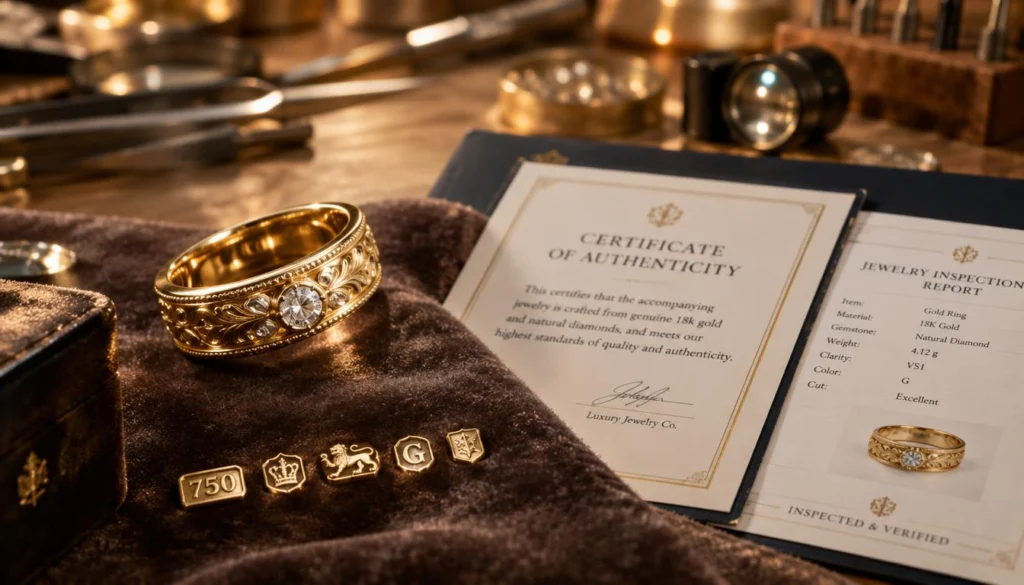
Use a hallmark and supporting paperwork as evidence to examine, not automatic proof that every claim is authentic. A hallmark is a mark on a piece of jewelry that states its metal fineness and may identify its maker or assaying authority. The distinction matters because an attractive close-up can show a stamp without establishing who applied it or whether the piece matches the description.
Judge quality from stated materials and documentation, not from a polished image or a stamp by itself.
Compare Gold, Platinum, and Plated Pieces
Solid 18-karat gold is 75% gold, with the remaining metal made up of other alloys. PT950 platinum is 95% platinum. Both are forms of solid-metal jewelry, meaning precious-metal jewelry with no plating over a base metal. Gold-plated pieces have a gold layer over another material; the underlying construction may be base metal. Ask what that base is if the listing does not say. A plated surface is not equivalent to solid gold, even when the color looks similar.
Read Hallmarks and Gemstone Reports
Jewelry hallmarks offer a useful clue to fineness, but a stamp alone does not conclusively authenticate a piece. For a diamond, an independent diamond grading report records characteristics assessed by a gemological laboratory. A GIA diamond grading report describes a diamond’s grading characteristics, but it does not guarantee the diamond’s resale value. A report is documentation about the stone, not a promise about what a future buyer will pay.
A luxury jewelry guide for women should still begin with the wearer’s materials preferences, sensitivities, and intended use, rather than assumptions based on gender. A ring worn daily, for example, calls for different practical priorities than an occasional pendant.
Check the Product Listing Beyond Its Photos
Before deciding that the description is complete, look for four concrete details:
- Stated metal and fineness.
- Gemstone details and any grading report.
- Clear close-up photographs of the piece and its markings.
- Written disclosures about treatments or alterations.
Once the construction and claims are clear, you can consider which design house, if any, fits your taste.
Which Jewelry Houses Fit Your Style and Priorities?
One buyer may prefer a recognizable motif, while another wants a more understated design; both can find a fitting house. Personal fit comes from the details you want to wear, not from a label’s position on a list.
Compare jewelry houses by design, craftsmanship, documentation, service, and budget rather than treating any brand ranking as an objective verdict. These examples identify recognizable signatures without declaring one house best.
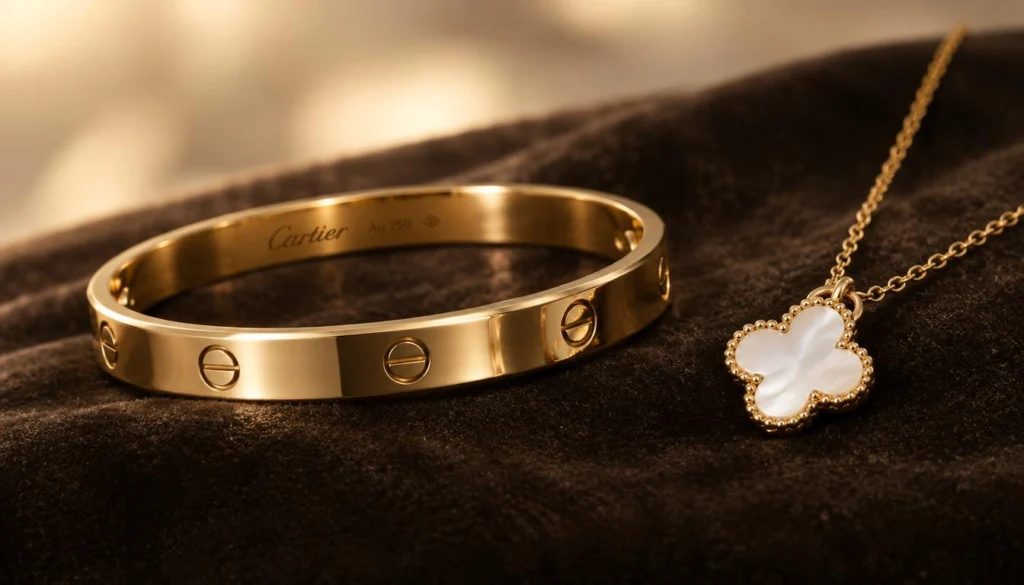
Identify Design Signatures
Cartier is associated with the Love and Juste un Clou bracelets, Trinity rings, and Panthère collection. Van Cleef & Arpels is associated with Alhambra motifs and Mystery Set pieces. Tiffany & Co. introduced the Tiffany Setting in 1886 and is also known for Elsa Peretti designs. Bulgari’s Tubogas and Serpenti designs offer a different visual language, while Harry Winston is known for diamond jewelry and cluster settings.
| Jewelry house | Recognizable design or technique | Named example |
|---|---|---|
| Cartier | Bracelet and ring designs | Love |
| Van Cleef & Arpels | Clover-inspired motifs and intricate stone setting | Alhambra |
| Tiffany & Co. | Engagement-ring setting and designer jewelry | Tiffany Setting |
| Bulgari | Flexible Tubogas technique and serpent motifs | Serpenti |
| Harry Winston | Diamond-focused cluster settings | Diamond jewelry |
Compare Houses Without Treating Rankings as Facts
A Top 20 luxury jewelry brands list or a Top 50 luxury jewelry brands list depends on the criteria used to select and order the names. A luxury jewelry brands ranking cannot measure how a particular design looks on you or guarantee its resale performance. Lists may organize brands by recognition, product range, or another measure, so their order is not a personal recommendation.
Use named collections as a starting point for comparing shape, finish, and scale. Then weigh the piece’s craftsmanship and documentation against the budget and service you expect. The label can narrow your search, but the piece itself has to earn regular wear.
Which Timeless Pieces Belong in a First Collection?
A buyer choosing between a striking occasion piece and a simpler item they could wear repeatedly should start with the way each fits daily life. Versatility can make a modestly scaled piece more useful than a dramatic design that stays in its box.
No piece is a mandatory first purchase; choose according to wear frequency, comfort, scale, and the clothes you already own. Diamond stud earrings can work across settings, while a solid gold chain may suit someone who prefers a clean line at the neckline. A tennis bracelet, cuff or bangle, or watch-jewelry hybrid can also be a starting point, depending on your routine and taste.
Everyday Pieces That Work Across Outfits
Think about whether you wear earrings every day, layer necklaces, or need jewelry that stays comfortable at a desk. Scale matters: a chain that sits well with a crewneck may disappear under a high collar, and a bracelet can catch on a sleeve. These are possible directions, not a shopping checklist you must complete. Chopard, Graff, Mikimoto, Boucheron, and David Yurman are examples in a list of luxury jewelry brands, not a ranking of what you should buy.
Before choosing, consider these five questions:
- How often will you wear it?
- Does the fit and closure suit your hands and routine?
- Will it remain comfortable during a full day?
- How much care does it demand?
- Does it work with items you already own?
Bracelets and Statement Pieces for More Personal Style
A cuff or bangle may suit a wearer who likes a defined shape, while a flexible tennis bracelet offers a different feel and movement. A larger statement piece can be right for someone who dresses for events or enjoys making jewelry the focal point of an outfit. Consider how its scale sits beside a watch, sleeves, or other pieces you wear often.
Asked what is the hottest jewelry right now? Trend-led styles shift with the season, and no single piece is universally hottest. A current styling trend can add interest for a while; a personal staple is the piece you continue choosing after that moment passes. Narrow the choice to what fits your routine, then turn to the practicalities of buying and looking after it.
How Can You Buy and Care for Fine Jewelry Online?
Checkout terms matter as much as the product description. Before paying, know what happens if the piece does not suit you and what documentation or support comes with it.
Review the seller’s written terms before ordering, and follow care guidance suited to the specific piece. Price depends on factors such as metal, gemstones, craftsmanship, and brand; check the current listing for the actual price and terms. Return and exchange terms, shipping and insurance details, authenticity documentation, warranty coverage, and available repair support can differ, so read each policy rather than assuming one seller’s terms apply elsewhere.
Know the return, shipping, documentation, warranty, and repair terms before you pay.
Confirm the Seller’s Policies Before Checkout
Look for the conditions, time limits, and exclusions in the return and exchange language. Check how shipping is handled and whether insurance is described, then confirm which authenticity documents are included. Warranty coverage and repair support are separate questions: a warranty may not cover every service, and repair options may depend on the item. Keep a copy of the listing and written terms tied to your order.
Protect Pieces in Storage and Wear
Store pieces separately in soft pouches or individual compartments to reduce tangling and contact between items. Keep jewelry away from chemicals, and remove it before swimming, showering, or exercising. Have settings, prongs, and clasps inspected periodically by a qualified jeweler, especially on pieces you wear frequently. Delicate or treated gemstones may need care specific to their material, so do not assume one cleaning method suits every piece. Verify the terms before paying, then match care to the specific item.
Conclusion
Confidence comes from matching evidence about the piece with a clear reason to wear it. Verify what the jewelry is made of, and choose for the wearer’s real habits rather than for a label alone. That approach keeps the purchase grounded in both the item and the life it will join.
Choose one piece you are considering and check its metal and gemstone documentation alongside the seller’s return terms. If those details support the purchase and the piece fits its intended use, you can make the decision with a clearer view of what you are buying. Complete that check before making a purchase.
Explore more in our luxury jewelry overview covering this pillar.
Related reading: engagement ring styles · tennis necklace · 3 carat diamond ring.
How we research: EliteSoda desk-researches brand sites, auction houses, authorized dealers, and established marketplaces such as Chrono24 and major hotel/resort directories. We do not invent lab tests, prices, or quotes.
Where does affordable luxury jewelry start?
Affordable luxury jewelry usually means solid 14k gold, sterling silver with gold vermeil, or small natural or lab-grown diamonds, often priced between a few hundred and a couple of thousand dollars. For luxury jewelry news such as new collections, price increases and gold-price moves, the brands’ own press pages and GIA research are more reliable than social media.
By the numbers: Precious-metal purity is standardized: 18k gold is 75% gold, 14k is 58.3%, and 10k is 41.7% (fineness reference). In the United States, the FTC Jewelry Guides, 16 CFR Part 23 do not allow pieces under 10 karats to be marketed as gold, and GIA grades diamond color on a D-to-Z scale.
Frequently Asked Questions
What is the 2:1:1 rule in jewelry?
There is no universally standardized jewelry rule called the 2:1:1 rule. If a styling source uses that ratio, its meaning depends on that source’s formula, such as how it groups or proportions accessories. Check what the numbers refer to before applying it. A ratio can be a useful styling prompt, but it does not replace judging how the pieces look with your outfit.
What are the top 10 luxury jewelry brands?
Ten recognized examples are Cartier, Van Cleef u0026amp; Arpels, Tiffany u0026amp; Co., Bulgari, Harry Winston, Graff, Chopard, Boucheron, Chaumet, and Mikimoto. This is an example list, not an objective ranking. Recognition does not tell you which design will suit your taste, how a specific piece is documented, or whether its price fits your budget. Compare the actual items you are considering.
What is the rule of 3 in jewelry wearing?
The rule of 3 is an informal styling guideline for limiting or grouping accessories, not a fixed rule everyone follows. Some people use it to keep a look from feeling crowded or to create a small group of coordinated pieces. Balance and outfit scale matter more than a set number: three large pieces can feel busier than several delicate ones, depending on clothing and occasion.
What jewelry do wealthy people wear?
There is no single type of jewelry worn by all wealthy people; preferences vary by person, culture, occasion, and taste. Some choose discreet pieces, while others prefer visible designs or wear little jewelry at all. For your own purchase, materials, design, comfort, and the occasion are more useful criteria than assumptions about an income group. A high price alone does not make an item a good fit.
What are the best quiet luxury jewelry brands?
“Quiet luxury” describes a preference for restrained design, not an official brand category with a definitive ranking. You might explore houses whose individual pieces have subtle forms or minimal visible branding, then judge each design on its own. The style can vary within one house, so a brand name alone does not guarantee a quiet look. Consider scale, finish, and how the piece works with your wardrobe.
What jewelry makes you look classy?
Proportionate, well-maintained jewelry that suits both your outfit and your personal style can create a polished look. A simple chain may feel appropriate with one outfit, while a bolder piece may work better with another. No material or price alone guarantees that effect. Pay attention to scale, condition, and whether the jewelry competes with other details you want to emphasize.
What is the cheapest luxury jewelry brand?
There is no single universal answer because entry prices vary by piece, material, and market. A small pendant and a gemstone ring from the same house can occupy very different price points, and prices may change across markets. Compare like-for-like items with similar materials and design complexity, then check current listings for actual prices. The least expensive option is not automatically the best value for your needs.
Is Tiffany or Van Cleef better?
Neither Tiffany u0026amp; Co. nor Van Cleef u0026amp; Arpels is universally better; the choice depends on your design preference, craftsmanship expectations, documentation, service, and budget. Compare specific pieces rather than deciding from the house name alone. You may prefer the look of one collection and the scale or details of another. The right choice is the item that meets your priorities and suits the person who will wear it.
Sources and further reading
Prices, availability and specifications change; we check brand and retailer pages before each update. See our editorial standards.