Elite Soda is reader-supported. When you buy through links on our site, we may earn an affiliate commission at no extra cost to you. Read our affiliate disclosure.
This article may contain affiliate links. See our Affiliate Disclosure. For the wider category, see our watches & jewelry guide.
You may love the look of an oval diamond and still wonder which design will suit it. Engagement ring styles bring together the diamond’s outline, the setting that holds the center stone, and your personal style, so a choice that works beautifully for one wearer may not suit another. Your preferences matter as much as convention.
A diamond shape is the outline of a diamond viewed from above, distinct from its cut quality. The shape gives a ring its visual character, while the setting and other details influence how that character comes across. There is no single style that suits every stone or wearer. A considered design can complement the center stone without asking you to follow a rule that does not feel right.
Key Takeaways
- Choose a design that complements the diamond’s outline.
- Shape describes appearance, not cut quality.
- A setting affects both the ring’s look and its coverage.
- Metal color and band details reflect personal preference.
- Comfort and daily wear belong in the decision.
The shape-by-shape guidance below offers starting points, not prescriptions, so you can compare ideas and decide which combinations feel right to you.
Which Engagement Ring Styles Suit Each Diamond Shape?
If you like a round diamond, choose a simple solitaire for a clean, traditional look, or add decorative details if you want more visual texture. Either direction can work, and a round brilliant cut is a traditional pairing for a solitaire setting. Use shape as a design starting point, not a rule.
Use shape as a design starting point, not a rule. The right pairing is the one that complements the stone and suits your taste.
Proportions can affect the impression a design creates: a band or surrounding detail may emphasize a stone’s length, symmetry, or outline. Compare the whole ring, rather than judging the center stone in isolation.
Round, oval, and cushion diamonds
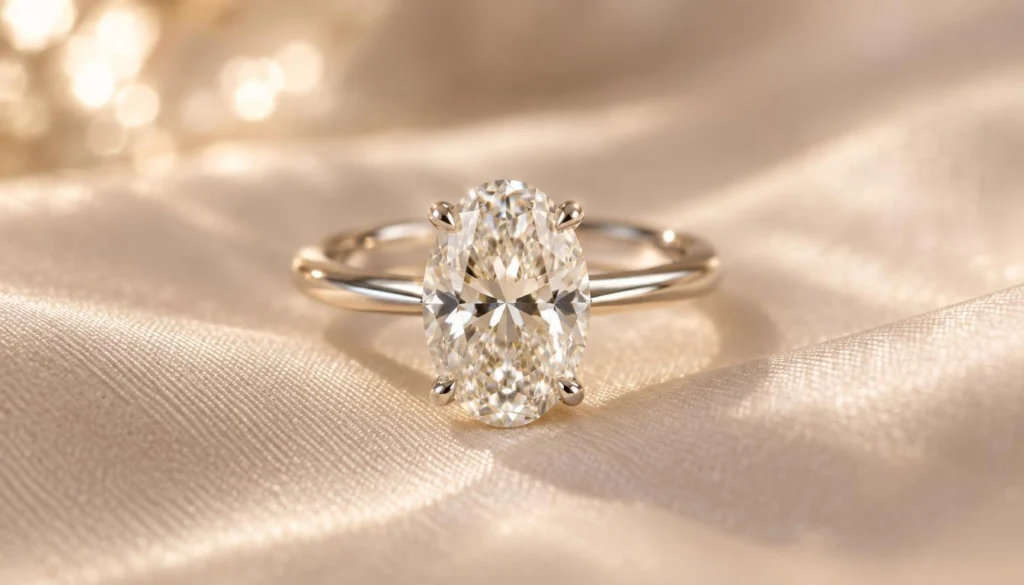
A round diamond suits a solitaire particularly well, though a halo or side stones can add more detail. An oval diamond’s elongated outline can make a design feel graceful; a simple band keeps attention on the center stone, while a halo creates a more embellished look. Cushion diamonds have rounded corners and a softer, often vintage-leaning character. A plain band can let that outline stand out, while a halo can add definition.
Emerald, marquise, pear, and other distinctive shapes
An emerald-cut diamond has a long, rectangular outline and broad, step-like facets, so restrained designs often complement its clear geometry. A marquise diamond’s pointed ends and elongated profile suit a slim band or a setting that follows its length. Engagement ring styles for marquise diamonds can make that outline the defining feature, creating a distinctive look. Pear-shaped diamonds also draw the eye along a lengthened outline; a design that follows its tapered form can feel balanced. These pairings are options, not rules. Shape helps narrow the design direction, while the setting determines how open or protected the center stone appears.
How Do Settings Change the Look and Security?
A plain solitaire band keeps attention on the center stone, while a halo frames it with surrounding stones for extra sparkle. The difference is visible, but not a change in the diamond itself: a halo can make the center appear larger without changing its actual size.
The setting also affects how much of the center stone is exposed or covered. An open design shows more of the diamond, while added metal can provide more coverage. The balance depends on the look you want and the shape being held.
Solitaire, halo, and three-stone settings
A solitaire setting places the center stone on its own, often with a simple band. Engagement ring styles with solitaire settings suit readers who want the diamond to remain the focal point. A halo setting surrounds it with smaller stones, adding sparkle around the outline. A three-stone setting places two stones beside the center stone; the design is commonly associated with past, present, and future.
Bezel, pavé, channel, and vintage details
A bezel setting holds a stone with a solid or partial metal rim, giving its edge coverage. Pavé settings place small stones close together along a band, while channel settings hold stones between metal walls. These details create different patterns and degrees of openness, so inspect how each meets the center stone and band.
Vintage-inspired details can include filigree, engraving, floral accents, and milgrain, a tiny beaded metal border. They add texture without requiring a particular diamond shape. Once you know which features appeal to you, a side-by-side comparison can help you narrow the design choices.
How Do Diamond Shapes Compare in a Quick Chart?
A comparison by shape can help you narrow choices before deciding on details. This engagement ring styles chart contrasts the visual impression of five popular outlines with design directions and practical considerations.
Use the chart to shortlist possibilities, then compare the actual ring designs. Diamond proportions and the relationship between shape and setting affect how a finished ring looks, so the same general pairing may feel different from one design to another.
| Diamond shape | Visual impression | Design pairing | Practical consideration |
|---|---|---|---|
| Round | Symmetrical, familiar outline | Solitaire or halo | Check that surrounding details do not distract from the center |
| Oval | Elongated, softly rounded outline | Simple band or halo | Compare how the length sits across the finger |
| Emerald | Rectangular outline with linear facets | Clean band or three-stone design | Choose a setting that suits the stone’s defined corners |
| Marquise | Long outline with two pointed ends | Slim band or protective details | Consider coverage at both points |
| Pear | Tapered outline with one pointed end | Band that follows its length | Consider protection at the tip and the direction it faces |
The chart narrows the field, but the band and its finish also influence the overall effect. From here, compare metal color and band design according to your preferences.
Which Metal and Band Details Personalize the Ring?
If you prefer a warm color, yellow gold offers a different look from cool-toned white gold or platinum. Color is a personal choice, and upkeep and appearance can vary with the alloy and finish.
Gold engagement ring styles span distinct shades: yellow gold looks warm, white gold has a cooler appearance, and rose gold has a pink tone. Engagement ring styles in gold can range from polished, simple bands to designs with more surface detail. White gold is commonly rhodium plated, so its finish may need periodic attention.
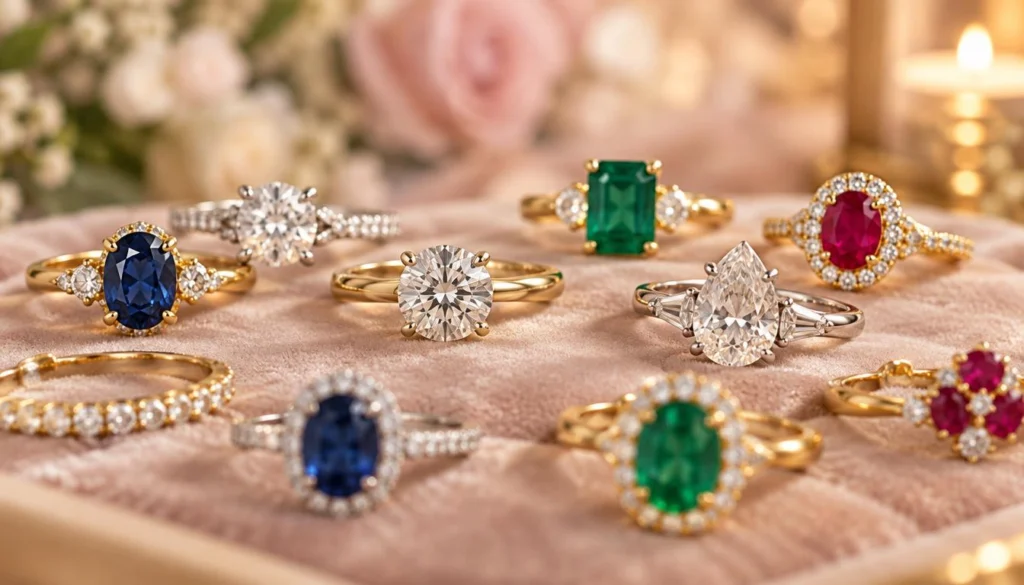
| Metal | Appearance | Upkeep consideration | Style effect |
|---|---|---|---|
| Yellow gold | Warm yellow color | Appearance can vary by alloy and finish | Classic warmth |
| White gold | Cool, bright color | Commonly rhodium plated; finish may need periodic attention | Clean, cool-toned look |
| Rose gold | Pink-toned color | Appearance can vary by alloy and finish | Soft warmth with a distinct hue |
| Platinum | Cool-toned metal | Appearance can vary with finish | Substantial, understated look |
The band profile also changes how a ring looks on the hand: a narrow band can feel visually delicate, while a broader profile makes a stronger line. After appearance, consider how the ring will work for the person wearing it each day.
What Should Everyday Wearers Consider Before Choosing?
A ring that looks appealing in a display may catch on a sweater sleeve during an ordinary task. That small snag matters if it happens often, so consider fit, setting height, exposed points, and your routine before settling on a design.
Try the ring on and notice whether the band feels comfortable as your hand moves. A raised setting can catch on clothing or objects, while a lower profile may feel less exposed. Pointed ends on pear and marquise diamonds can benefit from protective setting details. Hand activity also affects how often a ring may meet hard surfaces, and cleaning access varies with the design. Engagement ring styles for men follow the same practical considerations: comfort and design preferences matter more than gendered conventions.
- Try the ring on and assess comfort as you move your hand.
- Check whether the setting height catches on clothing or objects.
- Look for protection around pointed diamond ends.
- Consider how your routine affects the ring’s exposure to knocks.
- Ask what care the chosen setting needs.
Once practical needs are clear, you can focus on the personal details that make a design feel like your own.
How Can You Make a Ring Feel Personal?
A wearer might choose a sapphire instead of a diamond, or place stones in an asymmetrical design, to make the ring reflect a particular taste. An unexpected choice can feel considered, and personal details work best when they fit both your preferences and the way you plan to wear the ring.
Personal details work best when they fit both your preferences and the way you plan to wear the ring. An unexpected choice can still feel considered.
Unique engagement ring styles can start with alternative gemstones such as sapphires, rustic diamonds with a less uniform look, or unusual cuts such as hexagons. “Engagement ring style names” may help you describe a look, but a label cannot capture every detail of a design.
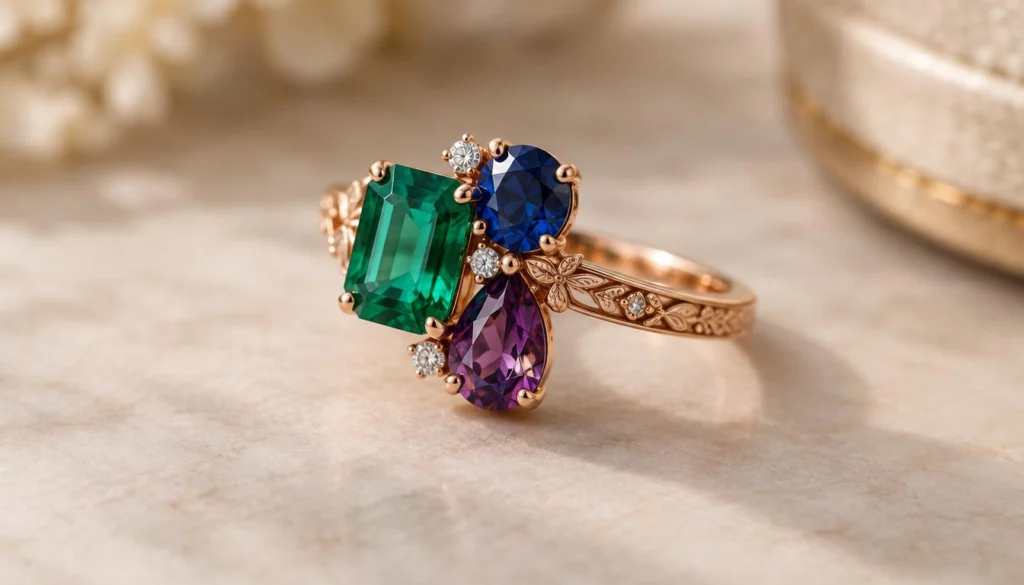
Alternative stones and asymmetrical designs
An asymmetrical design can place stones at different angles or combine a larger center stone with smaller accents. Sapphires and other alternative gemstones offer a color option beyond a traditional diamond, while rustic diamonds and hexagonal cuts bring a less familiar surface or outline. Engagement ring styles for women need not follow one prescribed look; the wearer’s preferences can guide the design.
Meaningful details that still suit daily wear
Personal details can be subtle: an engraved date or phrase inside the band, a floral accent, or another nature-inspired element. Keep the detail connected to the design, rather than adding features simply because they are available. A four-question engagement ring styles quiz can help organize your shortlist, but it cannot choose for you.
- Which stone do you prefer: a diamond, sapphire, or another gemstone?
- What visual mood appeals to you: minimal, vintage-inspired, or unconventional?
- Which metal color feels right to you?
- What daily-wear needs should the design meet?
Your answers can turn a broad search into a few combinations worth trying, making the final choice simpler and more confident.
Conclusion
The best choice balances the center stone’s appearance with the wearer’s preferences. A familiar convention can be a useful starting point, but it is only an option; comfort, style, and budget are personal decisions.
Shortlist two or three combinations of diamond shape, setting, and metal, then try comparable designs on. Seeing them on your hand can reveal differences that are hard to judge from a description alone. Notice how each feels as you move, and choose the one that suits your comfort and personal taste.
Explore more in our engagement ring styles overview covering this pillar.
Related reading: luxury jewelry · tennis necklace · 3 carat diamond ring.
How we research: EliteSoda desk-researches brand sites, auction houses, authorized dealers, and established marketplaces such as Chrono24 and major hotel/resort directories. We do not invent lab tests, prices, or quotes.
By the numbers: GIA grades diamond color on a D-to-Z scale and clarity across 11 grades, from Flawless to I3. One carat equals 200 milligrams (0.2 g), per this carat (mass) reference, so a 1.5-carat center stone weighs 0.3 g. Two stones of the same weight can differ widely in price because of cut, color, and clarity.
Frequently Asked Questions
What type of ring is used for engagement?
A ring with a center stone is a common choice for an engagement, often with a diamond, but no particular stone or design is required. Some people choose a gemstone, a plain band, or a design with no center stone. The best option depends on the wearer’s preferences, practical needs, and budget, rather than a single standard.
Is VS1 or VS2 better diamond?
VS1 has fewer or smaller inclusions than VS2, though both grades are classified as very slightly included. The visible difference between them can be difficult to detect without magnification. A grade alone does not determine which diamond you will prefer; compare the stones’ appearance and other characteristics alongside the grading information.
What is the 3 month rule for ring?
The three-month rule is a traditional spending guideline, not a requirement. It suggests spending an amount equivalent to three months of income, but there is no universal amount a person must spend on an engagement ring. A budget that fits your finances and priorities is more useful than following a fixed multiple.
How much should I spend on an engagement ring if I make $100,000 a year?
There is no required income-based formula for someone earning u0026#036;100,000 a year. The traditional three-month guideline is not a rule, and an engagement ring does not need to cost a fixed share of your income. Choose an amount that fits your personal finances and priorities, including other expenses and savings goals.
What does u0022female with two ringsu0022 mean?
“Female with two rings” often refers to a woman wearing an engagement ring and a wedding band, though the meaning depends on context and personal preference. Some people wear both rings together, while others wear one, switch between them, or choose different arrangements. The phrase alone does not establish what the rings signify for a particular person.
Sources and further reading
Prices, availability and specifications change; we check brand and retailer pages before each update. See our editorial standards.