
Elite Soda is reader-supported. When you buy through links on our site, we may earn an affiliate commission at no extra cost to you. Read our affiliate disclosure.
This article may contain affiliate links. See our Affiliate Disclosure. For the wider category, see our automotive, yachts & aviation guide.
A buyer planning a multimillion-dollar commitment faces a different decision from a traveler pricing one private flight. A purchase means acquiring an aircraft and taking responsibility for its ongoing costs; a charter is typically priced by flight hour, with additional trip costs on the final bill. The right comparison depends on how you expect to fly, not just on one headline price. Aircraft type, route, travel dates, and availability all shape the amount you pay. An empty leg is a repositioning flight flown without passengers, usually to move an aircraft to or from a charter pickup. It can cost less, but may not suit travelers who need fixed timing.
Use the details below to weigh the financial commitment against your actual travel needs, then compare purchasing and chartering before examining either option in depth.
Key Takeaways
- Buying and chartering have different cost structures.
- Aircraft category affects purchase and charter prices.
- Ownership brings expenses between trips.
- Charter rates are not complete trip bills.
- Route, timing, and availability shape quotes.
Private Jet Cost: How Do Buying and Chartering Compare?
Buying an aircraft can cost from around $2 million to more than $100 million, while a charter is quoted by flight hour. The distinction is ownership versus access: a purchase gives you an aircraft and responsibility for its costs, while chartering lets you pay for a specific trip without carrying the fixed expenses of ownership.
A charter’s base hourly rate is a starting figure, not necessarily the final invoice. Trip-specific charges can raise the total, so private aviation pricing is best compared using complete quotes for the same itinerary. A purchase price, by contrast, is the upfront cost of acquiring the aircraft; it does not cover the expenses of keeping and flying it.
Buying means paying for an aircraft and its ongoing costs. Chartering avoids ownership expenses, but the base hourly rate is not the complete trip bill.
If you are considering a purchase, start by comparing aircraft categories and their typical price bands.
How Much Does a Private Jet Cost to Buy?
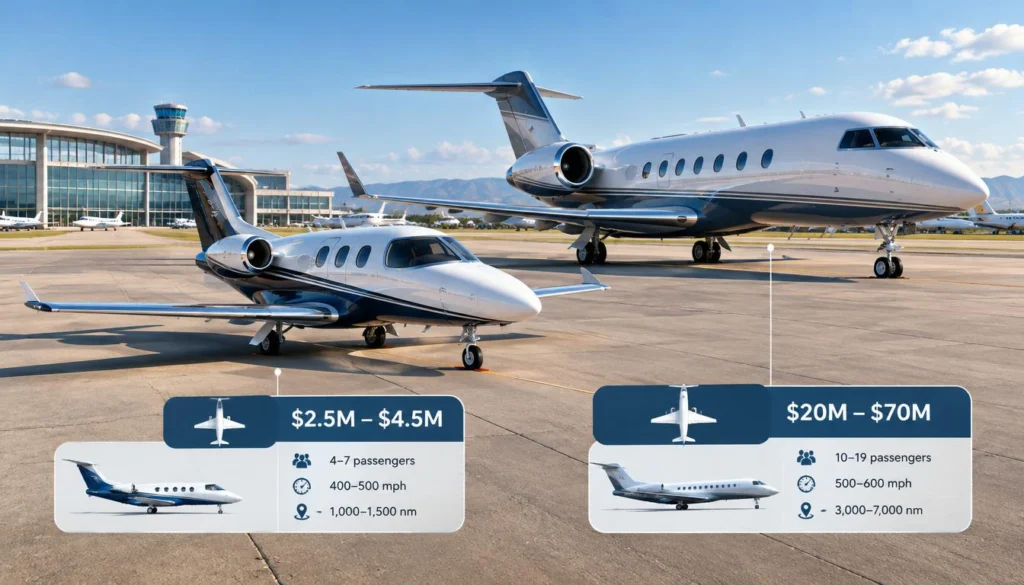
To estimate a private jet purchase price, first choose an aircraft category, then decide whether a new or pre-owned plane fits your budget. Category sets the broad range, while age, condition, and equipment help determine where a specific aircraft lands within it.
New aircraft generally cost more than comparable pre-owned models, and customization can add millions to the purchase price. A new plane offers a current cabin and equipment configuration; a pre-owned aircraft may cost less, though its maintenance history and condition deserve close attention.
New and Pre-Owned Jets
Typical prices vary substantially by size. The ranges below show common new and pre-owned purchase prices, not a guarantee that every aircraft in a category will be listed at those amounts. Very light jets are often the least expensive category, and pre-owned examples can fall below $2 million.
| Aircraft category | New purchase price | Pre-owned price |
|---|---|---|
| Very light | $3.5 million-$7.6 million | Under $2 million |
| Light | $11.7 million-$14.3 million | $2 million-$7 million |
| Midsize/super-midsize | $18.2 million-$30 million | $5 million-$18 million |
| Large/ultra-long-range | $35.5 million-$85 million or more | $25 million-$60 million |
What Determines Private Jet Cost for Sale?
A private jet for sale is priced according to more than its category. Age and overall condition matter, as do maintenance history, installed equipment, and cabin features. A well-kept aircraft with desirable equipment can command more than an older plane in the same category. Conversely, a low asking price may come with deferred maintenance or a cabin that needs work.
Interior customization and upgraded electronics can add millions to the purchase price. That means two aircraft of the same model and age can carry different asking prices if their interiors, avionics, or maintenance records differ. When comparing private jet cost for sale, consider the aircraft’s specific configuration rather than relying on category alone.
Cheapest Private Jet to Buy
The cheapest private jet to buy is generally a very light jet, especially a pre-owned example. A lower asking price does not automatically make it the least expensive choice for your trip needs. Passenger count, range, and the condition of the aircraft all affect whether it is suitable.
A very light jet may work for a short trip with a small group, while a longer route or more passengers may require a larger category. Choose the aircraft that fits the mission, not only the lowest listing price. From there, factor in the costs that continue after the sale.
What Does It Cost to Own a Private Jet Each Year?
Annual jet ownership costs can run from hundreds of thousands of dollars to several million, depending on aircraft size, crew, utilization, and operating arrangements. The owner pays even between flights: fuel is only one part of the budget, and some expenses continue when the aircraft is not moving.
Fixed expenses can make ownership costly even when you fly only a few times. The annual total combines recurring commitments with charges tied to use, so your private jet cost per year depends on both the aircraft and your flying pattern.
Fixed Costs That Continue Between Trips
Fixed costs include crew salaries, hangar storage, insurance, and scheduled inspections. These expenses support the aircraft’s readiness and care, rather than billing only for time in the air. A lightly used aircraft can still require crew arrangements, protected storage, insurance coverage, and inspections. Low annual flight hours do not make those commitments disappear.
Operating arrangements also affect the annual ownership costs you carry. For example, the size of the aircraft and the crew needed to operate it influence the budget. Your own use matters, too, but fixed bills make the cost per flight hour look higher when you fly infrequently.
Flight-Linked Operating Costs
Variable expenses rise or fall with flying. Fuel, maintenance, and landing fees are among the costs tied to aircraft operation. More flight activity generally means more fuel use and more exposure to maintenance and airport charges. The aircraft’s size and operating setup shape how those costs add up.
Plan for both categories rather than treating the flight-linked expenses as the entire budget. A jet that sits in a hangar still brings fixed commitments; one that flies frequently adds more variable costs. Looking at both helps you compare ownership with the cost of booking individual trips.
When Ownership May Be Worth It
Ownership may make sense if you travel frequently on predictable routes and value control of the aircraft and schedule. The aircraft can be available for your needs, but that control comes with continuing financial responsibility. The break-even point depends on the aircraft and how much you use it, so there is no universal number of annual flight hours that makes ownership worthwhile.
If you fly occasionally or your travel plans change often, carrying yearly expenses may be less practical than paying for trips as they arise. For those travelers, charter pricing offers another way to fly without taking on annual ownership costs.
How Much Does It Cost to Charter a Private Jet?
Two aircraft can make the same trip at different hourly starting prices: a very light jet typically costs less per hour than a heavy jet. Aircraft category drives the starting point, with typical base charter rates ranging from about $1,500 to $20,000 or more per hour.
Multiply the base hourly rate by flight time only for a first estimate. A two-hour flight’s base-rate arithmetic does not account for routing, minimums, repositioning, or fees. The following charter hourly rates provide a comparison by aircraft category.
| Aircraft category | Typical base rate per hour | Cost driver or typical use |
|---|---|---|
| Turboprop/very light | $1,500-$3,000 | Small groups, shorter trips |
| Light | $2,500-$4,000 | Short to medium trips |
| Midsize | $4,000-$8,000 | More cabin space and range |
| Super-midsize | $5,000-$10,500 | Longer trips and larger cabins |
| Heavy/ultra-long-range | $8,500-$20,000 or more | Large groups and long-range trips |
How much it costs to rent a private jet depends on the aircraft and itinerary, not just the rate. How much it costs to fly by private jet for a day depends on flight time, aircraft availability, and the day’s itinerary, not simply the number of calendar hours. A day with one flight is not priced by treating every hour on the calendar as flying time. The base rate is not the complete charter bill, since trip charges can add to it.
Which Fees and U.S. Charges Can Raise a Charter Quote?
A quote based on flight hours can change once the operator prices the full trip. Route details matter: airport charges, timing, and where the aircraft is positioned affect which items appear on your bill.
U.S. charter flights are generally subject to a 7.5% Federal Excise Tax. A complete quote may also include several trip-related charges, though not every flight has every add-on.
- Federal Excise Tax, generally 7.5% for U.S. charter flights.
- Fuel surcharge, which may be included in the trip total.
- Landing or ramp-handling fees charged in connection with airport use.
- Crew overnight expenses when the itinerary requires an overnight stay.
- Aircraft repositioning charges when the aircraft must travel to or from the pickup.
Which charges apply depends on the route, airport, timing, and aircraft position. These details make private jet cost in the USA different from one itinerary to another, even when the flight time appears similar. Ask for an all-in charter quote so you can see the total for your planned trip, rather than comparing the base rate alone.
Private-jet passengers typically do not use the standard airline checkpoint. Security procedures and screening requirements can still vary by operator, airport, and trip. Once you know which charges apply, you can estimate the full trip budget more accurately.
How Can You Estimate a Private Jet Flight’s Total Cost?
Two travelers can get different estimates for a similar-length flight because their routes, travel times, or aircraft needs differ. Compare the full itinerary, not only the rate shown first by a private jet cost calculator.
A flight cost estimate is useful as a starting point, but the complete quote is what lets you compare trip totals. Enter the details consistently and check whether each estimate covers the same aircraft category, itinerary, and trip conditions.
- Enter the departure and arrival airports.
- Select an aircraft category that fits your passenger count and range.
- Enter your travel dates and timing.
- Compare the complete quote, including taxes, fees, repositioning, and any minimum-hour rules.
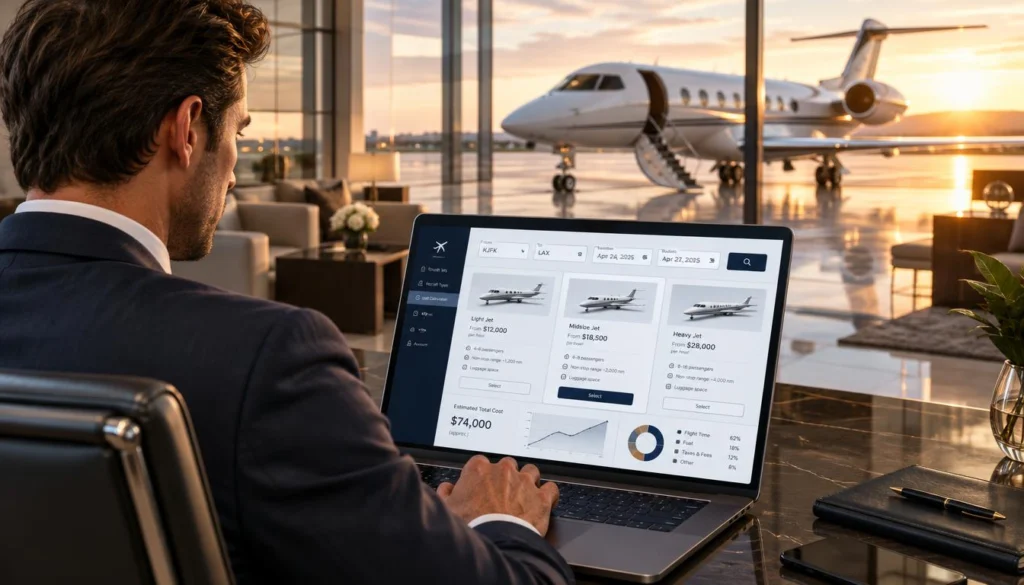
Calculator results are estimates and can change with availability, route, aircraft positioning, and itinerary changes. A different pickup airport or departure time can alter what aircraft is available and how the trip is priced. Compare like-for-like aircraft and itineraries, not just headline hourly rates. A complete itinerary and quote comparison gives you a sound basis for choosing the option that fits the trip.
Use the same route, timing, and aircraft needs when comparing quotes. The full itinerary matters more than a headline hourly rate.
Conclusion
The best option depends on how often you fly and how much flexibility your trips require. If you travel frequently on predictable routes, ownership may suit your need for control; if you fly occasionally, chartering can avoid taking on the costs of keeping an aircraft. In either case, compare the full cost for your expected use, not the purchase price or hourly rate alone.
Before requesting or comparing quotes, prepare your route, dates, passenger count, and aircraft needs. That gives you a clear basis for evaluating options against the trip you actually plan to take. Get an itinerary-specific all-in quote before making a commitment.
Explore more in our private jet cost overview covering this pillar.
Related reading: rolls royce phantom · superyacht charter · luxury car brands.
How we research: EliteSoda desk-researches brand sites, auction houses, authorized dealers, and established marketplaces such as Chrono24 and major hotel/resort directories. We do not invent lab tests, prices, or quotes.
Frequently Asked Questions
How much is a 2 hour flight on a private jet?
A two-hour private-jet flight can have a base-rate estimate of roughly $3,000-$40,000 or more, depending on aircraft category. That calculation multiplies the category’s hourly starting rate by two, but it does not guarantee the final quote. Fees, repositioning, and minimum-hour rules can increase the total, and the itinerary affects the amount you pay.
What is the cost of a private jet?
Buying a private jet can cost from around $2 million to more than $100 million, while chartering is priced by flight hour plus trip-specific charges. A purchase gives you an aircraft and responsibility for its ongoing costs. A charter lets you pay for a particular trip without taking on aircraft ownership, though the base rate is not the final bill.
How much does a private jet cost you?
Your personal cost depends on whether you charter or own. With a charter, you pay for the flight and applicable trip charges. Ownership can mean hundreds of thousands to several million dollars a year before considering how often you use the aircraft. Your aircraft category, utilization, and operating arrangements influence the total, so compare expenses against your expected travel.
Is owning a private jet worth it?
Owning a private jet can suit frequent travelers who value control and schedule flexibility. It also brings fixed expenses that continue between flights, which can make chartering more practical for occasional trips. The decision depends on the aircraft and how often you use it, rather than a universal flight-hour threshold. Consider your regular routes and travel patterns when weighing ownership.
Do you still go through TSA on a private jet?
Private-jet passengers typically do not use the standard airline checkpoint. That does not mean every trip follows identical security procedures: requirements can vary by operator, airport, and trip. The departure process is often arranged through a private terminal or fixed-base operator, but the specific screening steps depend on the arrangements for your flight.
Sources and further reading
Prices, availability and specifications change; we check brand and retailer pages before each update. See our editorial standards.