
Elite Soda is reader-supported. When you buy through links on our site, we may earn an affiliate commission at no extra cost to you. Read our affiliate disclosure.
This article may contain affiliate links. See our Affiliate Disclosure. For the wider category, see our automotive, yachts & aviation guide.
A buyer comparing two luxury vehicles may be weighing the badge, monthly budget, and daily comfort at the same time, especially when considering luxury car brands. Your U.S. car-buying budget, personal taste, and new-versus-used decision can each change which model makes sense. A starting MSRP is the manufacturer’s suggested retail price before options, taxes, registration, and dealer fees. It is a useful point of comparison, not a promise of what you will pay at the dealership.
A recognizable badge may catch your eye, but the vehicle still needs to suit your commute, passengers, parking, and plans for the car. A high price alone does not establish a good personal fit, and a model that looks appealing in a showroom may feel different on your usual roads. The useful comparison is between specific models and the way you expect to use them.
This practical comparison will help you weigh cost, prestige, driving character, features, and ownership needs. First, consider the different kinds of marques a shopper may encounter.
Key Takeaways
- Compare specific models, not just brand names.
- Use starting MSRP as a baseline, not an out-the-door price.
- Match the vehicle type to your daily passenger and cargo needs.
- Prestige reflects personal preference, not a model’s objective value.
- Check the exact model year and service history when shopping used.
Luxury Car Brands Compared by Category
A useful shortlist starts with the kind of driving experience and ownership style you want, not with a single winner. A luxury car brands list can include traditional luxury marques, automakers focused on EVs, sports-car makers, and ultra-luxury specialists.
“Top” depends on the definition: there is no universal ranking of luxury marques. The answer to “what are the top 20 luxury car brands?” changes depending on whether performance, exotic, and EV marques count.
There is no universal top 20: the answer changes with the kinds of vehicles you include.
Mainstream Luxury and Executive Marques
Mercedes-Benz, BMW, and Audi are core luxury choices, with broad lineups spanning sedans, SUVs, and other vehicle types. Lexus is Toyota’s luxury division, Acura is Honda’s luxury division, and Genesis is Hyundai Motor Group’s luxury brand. Each has its own identity and model range. Cadillac and Lincoln are American luxury marques, while Tesla and Rivian are EV-focused options for shoppers considering electric powertrains.
- Core luxury and luxury divisions: Mercedes-Benz, BMW, Audi, Lexus, Genesis.
- American luxury and EV-focused options: Acura, Cadillac, Lincoln, Tesla, Rivian.
- Performance and British marques: Porsche, Maserati, Alfa Romeo, Jaguar, Land Rover.
- Ultra-luxury and exotic names: Rolls-Royce, Bentley, Ferrari, Lamborghini, McLaren.
Performance, Exotic, and Ultra-Luxury Marques
Porsche bridges sports cars and luxury SUVs, giving it a place on both sides of that divide. Jaguar and Land Rover are British marques associated with sporty cars and luxury off-road SUVs. Rolls-Royce and Bentley are examples of ultra-luxury marques. Ferrari, Lamborghini, and McLaren are associated with exotic performance cars, while Maserati and Alfa Romeo bring distinct Italian identities to the wider performance category.
A top luxury car brands list may change if it ranks daily-use SUVs, performance cars, or EVs separately. Some shoppers also search for a top 20 luxury car brands list to get a broad range of options, but the groupings are more useful than a numbered order. This is a starting point, not a ranking of which marque is best for you. The next question is what these categories tend to cost.
What Do Luxury Cars Cost at Each Tier?
A new luxury vehicle can start near the price of a well-equipped mainstream vehicle or climb into six figures, depending on its class and equipment. As a broad U.S. rule of thumb, luxury car price tiers range from about $40,000 at the entry point to several hundred thousand dollars or more for bespoke and exotic vehicles. Starting MSRP is a baseline, not the final amount you pay.
Lower Entry Points and Mainstream Luxury
New entry-level luxury models often start around $40,000-$60,000, while many midsize luxury models start around $55,000-$90,000. These broad ranges can help you compare entry-level luxury cars and luxury car brands at cheaper price points without assuming that every model in a category costs the same.
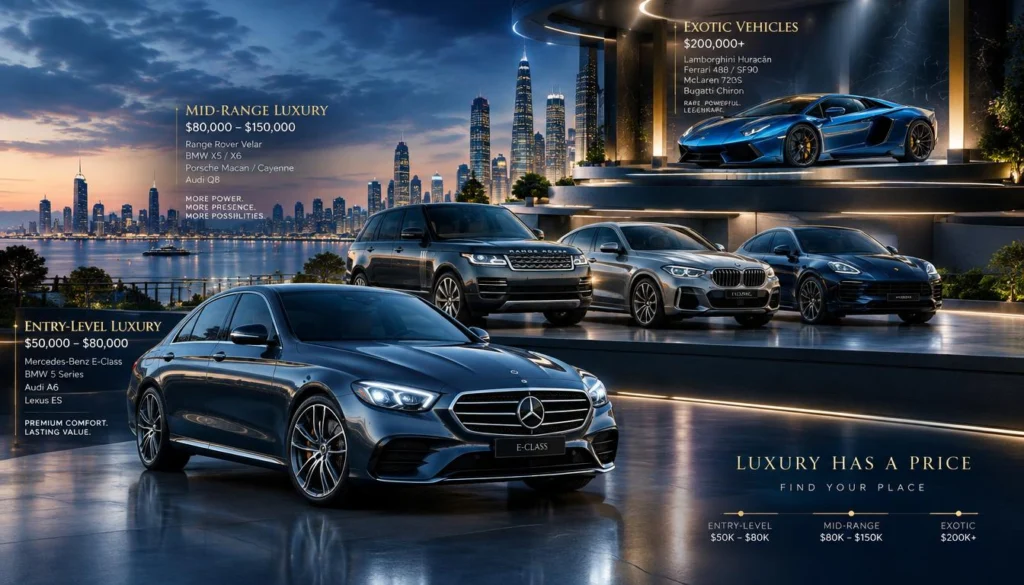
| Category | Typical new starting MSRP range | Examples | What the tier commonly prioritizes |
|---|---|---|---|
| Entry-level luxury | $40,000-$60,000 | Compact luxury sedan, compact luxury SUV | Premium cabin and everyday usability |
| Midsize luxury | $55,000-$90,000 | Midsize luxury sedan, midsize luxury SUV | More passenger space and equipment |
| Flagship luxury | Above $100,000 | Flagship sedan, large luxury SUV | Higher-end comfort and materials |
| Ultra-luxury or exotic | Several hundred thousand dollars or more | Bespoke luxury car, exotic sports car | Exclusivity and extensive customization |
Flagships, Exotics, and Cost Drivers
Flagship and ultra-luxury models can start above $100,000, while bespoke and exotic models can reach several hundred thousand dollars or more. Those are category-level ranges, not prices attached to specific models. A top 10 luxury car brands list is not a price ranking: a brand may sell vehicles at several price levels, and its most expensive offering may not be representative of its lineup.
Trim, options, powertrain, taxes, registration, and dealer fees affect the amount you pay. A more powerful engine or a package of added equipment can move the cost beyond the starting MSRP, so use an out-the-door quote to compare the exact vehicles. Options and fees make starting prices poor substitutes for that quote. The entry point is only one part of value, which leads to how prestige differs among marques.
How Does Prestige Differ Across Luxury Marques?
Two luxury vehicles at similar prices can signal very different things to their owners. Prestige is subjective: it may reflect a marque’s history, materials, personalization, design, motorsport or performance identity, and recognition where you live. A prestigious badge can express taste, but it does not establish a model’s objective value.
Craftsmanship, Heritage, and Exclusivity
Some shoppers value carefully finished interiors or a long-established history; others care more about a distinctive silhouette or the chance to personalize a vehicle. Exclusivity can also shape how a car is perceived. Those preferences are personal measures of luxury, not a universal test of how well a specific model suits your needs.
Maserati is an Italian luxury marque associated with Italian styling and a sporting identity. That association may appeal to a shopper who likes its design language, but it is not an endorsement or a measure of value. Bugatti, by contrast, is associated with high-performance hypercars, a specialized part of the market that may appear on prestige lists alongside more conventional luxury marques.
Design Identity and Brand Recognition
A badge can help you recognize a marque: Mercedes-Benz uses a three-pointed star, BMW a roundel, Audi four rings, Lexus an L emblem, and Porsche a crest. Searching for luxury car brands logos with names can help you identify those symbols, but recognition alone cannot tell you whether a particular model fits your driving and comfort needs.
Lists of the top 50 luxury car brands in the world vary because their compilers draw different boundaries. Some count specialist performance, hypercar, and EV marques; others use a narrower definition centered on traditional luxury vehicles. A familiar emblem may carry meaning for you or your community, but it is still only one part of a buying decision. Treat prestige as a personal preference, not a performance measure. Next, consider what the vehicle delivers on the road and inside the cabin.
Which Features and Performance Matter Most?
A quiet, comfortable commute and a responsive weekend drive call for different priorities. Start with how you will use the vehicle: body style, ride comfort, handling, passenger and cargo needs, and preferred powertrain can matter more than a long feature list. No one vehicle type is best for every buyer.
Driving Character and Vehicle Type
Luxury sedans and SUVs may put greater emphasis on comfort and space, while a sports car is shaped around a more focused driving experience. Porsche’s 911 is a sports car, while the Cayenne is an SUV, showing how one marque can offer very different kinds of vehicles. EVs add another powertrain choice, with its own driving feel and charging considerations.
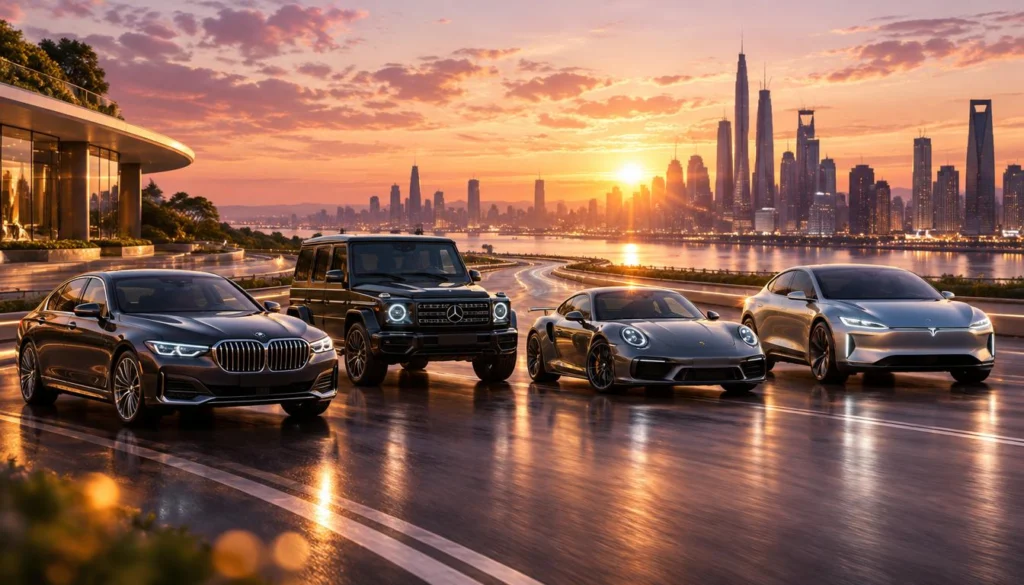
| Type | Representative model | Common strength | Trade-off |
|---|---|---|---|
| Luxury sedan | BMW 5 Series | Comfort for daily road use | Less cargo flexibility than an SUV |
| Luxury SUV | Lexus RX | Passenger and cargo versatility | Larger size may affect maneuverability |
| Sports car | Porsche 911 | Responsive, focused driving | Less space for passengers and cargo |
| Luxury EV | Tesla Model S | Electric powertrain and quiet travel | Charging needs differ from fueling |
Cabin Technology and Comfort
Compare seat comfort, cabin noise, climate controls, infotainment, and driver-assistance features in the specific models you are considering. A system that helps with routine highway driving may be useful to you, while another buyer may prefer fewer alerts and simpler controls. Check whether passengers have enough room and whether the cargo area fits the items you carry most often.
A long list of luxury car features matters less if you will not use them or find the interface distracting. Try connecting your phone, changing the temperature, and adjusting the seat before judging the cabin. Test the specific body style and controls you expect to live with. Then weigh ownership costs and reliability for the vehicles on your shortlist.
Which Luxury Brand Fits Your Ownership Priorities?
The right shortlist is the one that meets your needs after purchase, not just the one that looks impressive in a showroom. Ownership fit includes the costs and practical demands of living with a vehicle, along with the way it drives. A brand-wide reputation cannot establish which individual model is the most reliable.
Choose for the vehicle you will own day to day, not for the badge alone.
Use this checklist to compare candidates on the same terms:
- Total budget, including insurance and maintenance.
- New or used condition, plus service history for a used vehicle.
- Daily passenger and cargo needs.
- Preferred powertrain and driving feel.
- Model-year-specific reliability information.
Luxury car ownership costs can include more than the purchase price, so factor recurring insurance and maintenance into what you can comfortably spend. The new-versus-used choice also changes what you need to examine: maintenance records matter when comparing used vehicles, and a vehicle’s service history helps show how it has been cared for.
Lexus is commonly associated with long-term reliability, but that reputation does not guarantee the outcome for every model or model year. Reliability varies across models and years, and a brand’s reputation cannot tell you which specific vehicle will be the most dependable. Use model-year-specific information and the vehicle’s own records when you compare options. To narrow the choice, test-drive the best-fitting models and compare the full costs of the exact vehicles under consideration.
Conclusion
A luxury badge matters less than whether the vehicle suits your budget and everyday life. The best fit depends on what you want to spend, how you prefer a vehicle to drive, and which features you will actually use. A comfortable, well-equipped option that works for your routine may be a stronger choice than a more prestigious model that does not.
Select two or three suitable models, check current pricing and ownership details for those exact vehicles, and arrange test drives. Compare the cabin, controls, and driving feel in person, then weigh the complete costs side by side. After the test drives, compare your two or three finalists before choosing.
Explore more in our luxury car brands overview covering this pillar.
Related reading: rolls royce phantom · superyacht charter · private jet cost.
Frequently Asked Questions
What is the top 10 expensive car?
There is no definitive top 10 expensive-car ranking because lists count different things. Some include production cars, limited builds, or bespoke options, while others use auction prices, which can differ from a new car’s listed price. Hypercars can cost millions, but the order and vehicles included depend on the ranking’s rules and the specific cars being compared.
What is the cheapest luxury car brand?
No single luxury brand is cheapest across all its models. A brand may offer a lower-priced compact model and also sell large SUVs or flagships at much higher prices. Compare current starting prices for the entry models you are considering, then account for trim, options, taxes, registration, and dealer fees to judge what each exact vehicle would cost.
What is the poor man’s luxury car?
“Poor man’s luxury car” is an informal label, not a recognized vehicle class. People may use it for an entry-level luxury model or a used premium car purchased at a lower price than when new. A used luxury vehicle can still have higher potential maintenance costs, so its asking price alone does not show whether it fits your budget.
What is the #1 luxury car?
There is no universal number one luxury car. The answer changes with your priority: one shopper may value a quiet ride and comfortable seats, while another may focus on handling, technology, or reliability. Compare specific models against your driving routine and budget, then consider how their features work for you during a test drive.
What are the top 10 most reliable luxury cars?
No fixed top 10 is reliable for every model year and every measure of dependability. A reasonable starting shortlist includes the Lexus ES and RX, Acura MDX and RDX, and Genesis GV70. Check reliability information for the specific model year you are considering, and examine maintenance records for a used vehicle before comparing it with another candidate.
Can you give me a list of luxury cars?
Examples across different vehicle types include the Mercedes-Benz E-Class, BMW 5 Series, Lexus RX, Porsche 911, and Tesla Model S. The E-Class and 5 Series are sedans, the RX is an SUV, the 911 is a sports car, and the Model S is an EV. Those examples offer different driving experiences, so compare the type as well as the badge.
What is the most unreliable luxury car brand?
It is not accurate to label an entire luxury marque the most unreliable based on brand name alone. Reliability varies by model, model year, maintenance, and the measure used to assess it. For a specific candidate, look for information that matches its year and version, and review its service records if it is used rather than relying on a broad reputation.
Which luxury car lasts the longest?
Lexus has a reputation for longevity, but no brand guarantees how long an individual vehicle will last. Maintenance, driving conditions, and the way a particular car has been cared for all matter. When comparing used options, review service history and the specific model year; a well-maintained vehicle can tell you more than a badge by itself.
Sources and further reading
- IIHS vehicle safety ratings
- US DOE/EPA fuel economy data
- LVMH group maisons and annual reports
- Bain & Company luxury market insights
Prices, availability and specifications change; we check brand and retailer pages before each update. See our editorial standards.