Elite Soda is reader-supported. When you buy through links on our site, we may earn an affiliate commission at no extra cost to you. Read our affiliate disclosure.
This article may contain affiliate links. See our Affiliate Disclosure.
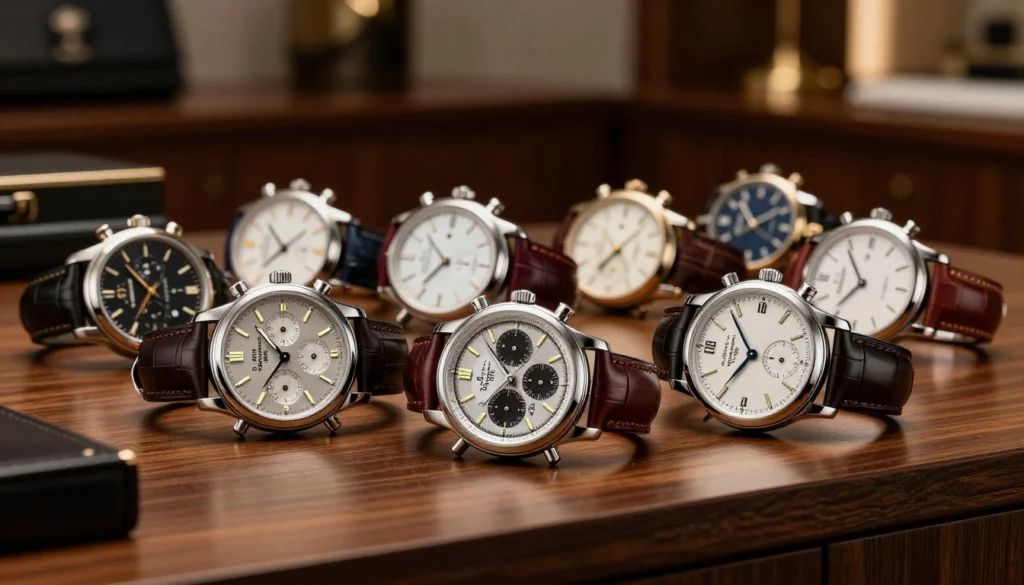
A chronograph is the one complication you will actually use. Here is how to choose a luxury chronograph worth keeping, from the movement inside to the models that define the category.
Of all the complications in fine watchmaking, the chronograph is the most generous. A perpetual calendar or minute repeater is admired; a chronograph is used: to time a parking meter, a steak, a lap, a flight. Press a pusher and a dormant mechanism springs to life, a central seconds hand sweeps, and small registers begin counting minutes and hours, while the watch keeps telling the time as if nothing had happened.
That everyday usefulness is why luxury chronograph watches sit at the heart of so many collections, and why the category is so crowded. This guide cuts through it. We explain what separates a great chronograph from a merely expensive one, which complications are worth paying for, and which models from Breitling, Omega, Rolex, Patek Philippe, Audemars Piguet and others deserve a place on a shortlist for US buyers.
Key takeaways
- A chronograph is a watch with a built-in stopwatch: start, stop and reset are controlled by pushers on the case.
- The movement matters most. Integrated, in-house calibres with a column wheel and vertical clutch are the benchmark for luxury chronographs.
- Flyback and monopusher designs add genuine function; a perpetual calendar chronograph is the summit of the category.
- Legibility, case size and how the pushers feel in use matter more day to day than any single specification.
- Buy from an authorized dealer or a reputable pre-owned specialist, and keep box, papers and service history.
What is a chronograph watch?
The word comes from the Greek for “time writer”. In practice, a chronograph is a watch with an independent timing mechanism. On most models the pusher at two o’clock starts and stops the chronograph, and the pusher at four o’clock resets it to zero. Elapsed seconds are read from the central hand; elapsed minutes and hours accumulate on sub-dials, usually called registers or counters.
Do not confuse a chronograph with a chronometer. A chronometer is a precision certificate: a movement that has passed accuracy testing, typically by COSC in Switzerland or, for Omega’s Master Chronometers, by the Swiss Federal Institute of Metrology (METAS). A watch can be one, the other or both.
Reading the dial: registers and scales
Two-register (“bicompax”) dials feel clean and vintage; three-register (“tricompax”) layouts add an hour counter and a busier, more technical look. Around the edge you will often find a tachymeter, a scale that converts elapsed time into speed over a known distance. Pilot’s watches such as the Breitling Navitimer replace it with a circular slide rule for calculations in the cockpit. Pulsometer and telemeter scales, once common, appear mainly on heritage-inspired pieces today.
What makes a luxury chronograph worth the price?
Two of these watches can look almost identical in photographs and differ by tens of thousands of dollars. The difference is mostly in places you cannot see in a product listing.
The movement: integrated, in-house and column wheel
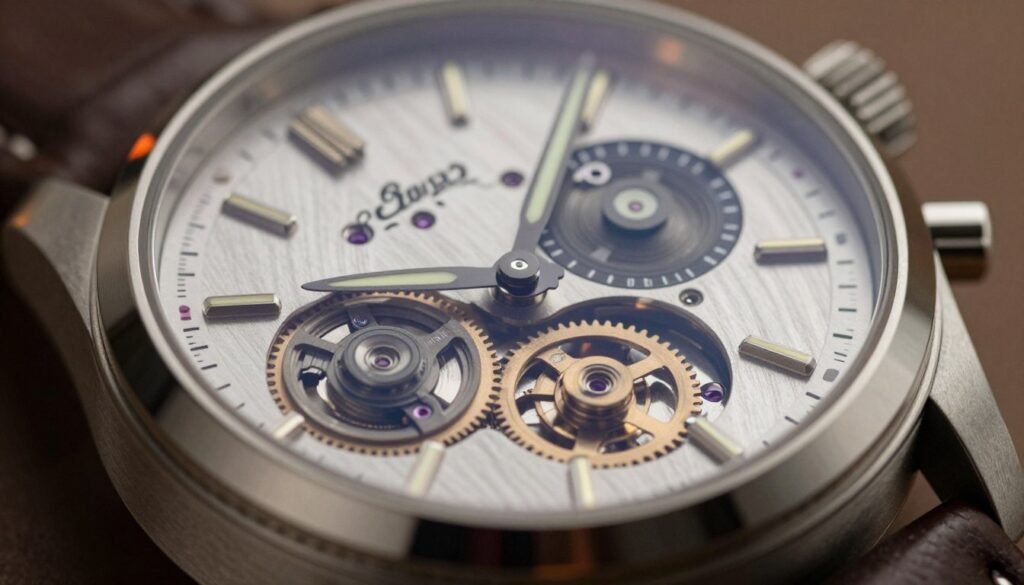
The most prestigious luxury chronographs use an integrated movement, where the timing mechanism is designed into the calibre from the start, rather than a modular one that bolts a stopwatch module on top of a simple base movement. Integrated calibres tend to be thinner, more robust and easier to service well.
Two further details separate the best from the rest. A column wheel coordinates the start, stop and reset functions with a crisp, precise feel at the pushers, where cheaper cam-actuated systems can feel stiff. A vertical clutch engages the stopwatch without the seconds hand stuttering, and lets the stopwatch run continuously as a running seconds hand without unnecessary wear. Breitling’s B01, Rolex’s 4131, Omega’s 3861 and 9900 families, Zenith’s El Primero and Patek Philippe’s CH 29-535 are all integrated, in-house calibres built around these principles.
Case, finishing and legibility
Look for crisp transitions between brushed and polished surfaces, applied rather than printed indices, and hands that stay readable against the dial in poor light. A chronograph dial carries more information than a three-hand watch, so balance is everything: registers should be easy to read at a glance, not crowded against the date window or brand logo.
Pushers, water resistance and comfort
Screw-down pushers, found on the Rolex Daytona and many dive-style chronographs, improve water resistance but must be unscrewed before use. Pump pushers are more convenient. Either way, check how the case wears: chronographs are thicker than simple watches, and a 42 mm case with a tall profile can feel much larger than its diameter suggests.
Complications worth paying for
Beyond the standard chronograph, a handful of variations add real usefulness, or real horological prestige.
Flyback chronographs
On a flyback, a single press of the reset pusher while the stopwatch is running returns the hands to zero and restarts timing immediately. It was developed for pilots timing successive legs of a flight, and it is still the most practical upgrade for anyone timing repeated intervals. Patek Philippe’s 5960, many Blancpain Air Command and Zenith Pilot models, and a number of Breguet Type XX references are flyback chronographs.
Monopusher chronographs
A monopusher uses a single button, often set into the crown, to start, stop and reset in sequence. The result is a cleaner case profile and a nod to the earliest wristwatch chronographs. Montblanc’s 1858 Monopusher and Panerai’s Luminor Chrono Monopulsante 8 Giorni, with its eight-day power reserve, are modern interpretations collectors seek out.
Rattrapante and perpetual calendar chronographs
A rattrapante, or split-seconds chronograph, adds a second central hand so you can record two times, a lap and a total, at once. It is among the most difficult complications to make. At the very top of the category sits the perpetual calendar chronograph, which tracks date, day, month and leap-year cycle without adjustment until 2100. Patek Philippe’s 5270 is the reference point.
| Design | What it does | Who it suits |
|---|---|---|
| Standard (two pushers) | Start/stop and reset | Most buyers; everyday timing |
| Flyback | Resets and restarts in one press | Pilots, athletes, interval timing |
| Monopusher | All functions from one button | Collectors who value purity and history |
| Rattrapante | Times two events at once | Advanced collectors |
| Perpetual calendar chronograph | Adds a self-correcting calendar | Grand complication collectors |
The best luxury chronograph watches to know
These are the models that define the category in 2026. Prices are approximate US retail or typical market ranges at the time of writing; they change often, so confirm with an authorized dealer before you buy.
Breitling Navitimer B01 Chronograph 41
The Navitimer is the pilot’s chronograph, instantly recognisable by its slide-rule bezel and busy, purposeful dial. The Navitimer B01 Chronograph 41 brings the design down to a size that suits most wrists while keeping Breitling’s in-house B01 calibre, a column-wheel, vertical-clutch movement with a power reserve of about 70 hours, visible through a sapphire caseback. Expect a list price of roughly $9,000 to $10,500 depending on dial and bracelet. It is one of the most searched-for luxury chronographs in the US for good reason: it is both a tool and a piece of aviation history.
Breitling Top Time, Avenger and Chronomat B01
The same B01 engine powers several very different personalities. The Top Time B01 revives a 1960s racing aesthetic, including the Shelby Cobra and Deus collaborations. The Avenger B01, notably the blacked-out Night Mission, is the tough, tactical option, while the Chronomat B01 with its “rouleaux” bracelet is Breitling’s polished all-rounder. Most sit in the $5,000 to $9,000 range, which makes them some of the best-value in-house chronographs on the market.
Omega Speedmaster Professional Moonwatch
The Speedmaster is the chronograph most people picture. Flight-qualified by NASA and worn on the Moon in 1969, the current Moonwatch keeps the 42 mm asymmetrical case, black tricompax dial and tachymeter bezel, now with the manually wound Master Chronometer calibre 3861. Roughly $7,000 to $8,500 on steel, it is arguably the most historically important watch you can buy new at this price.
Rolex Cosmograph Daytona
Named for the Florida speedway, the Daytona is the most coveted chronograph in the world. The current generation uses the in-house calibre 4131 with a 72-hour power reserve and screw-down pushers. Steel models carry a list price of around $15,000 to $16,000, but demand far outstrips supply at authorized dealers, so many buyers pay a significant premium on the secondary market. Precious-metal versions, including the Le Mans and platinum references, sit far higher.
Audemars Piguet Royal Oak Offshore Chronograph
If the Royal Oak is the original luxury sports watch, the Offshore is its louder, more athletic sibling: a larger octagonal case, prominent pushers and a “Méga Tapisserie” dial. Steel references start at roughly $35,000 to $45,000 on the pre-owned market, with rose gold, ceramic and limited editions, such as the Michael Schumacher model, well above that. It is a statement chronograph, best for buyers who want presence as much as precision.
Patek Philippe chronographs: 5172, 5960 and 5270
Patek Philippe treats the chronograph as an exercise in restraint. The 5172G is a classically proportioned manual-wind chronograph; the 5960 annual calendar flyback chronograph pairs a practical calendar with a single central counter; and the 5270 perpetual calendar chronograph is one of the finest grand complications in production. Expect prices from around $75,000 to well over $150,000. Earlier references such as the 5070 remain highly collectible on the pre-owned market.
Zenith Chronomaster Sport and El Primero
Zenith’s El Primero, introduced in 1969 as one of the first automatic chronographs, beats at a high 36,000 vibrations per hour and can time to a tenth of a second. The Chronomaster Sport puts it in a modern steel case with a ceramic bezel for roughly $11,000 to $12,000, a compelling alternative to the Daytona that is far easier to buy.
IWC Portugieser Chronograph
Proof that a chronograph can be elegant, the Portugieser Chronograph has a slim bezel, vertical two-register layout and in-house calibre. At roughly $8,000 to $9,500 it is a favorite for buyers who want one watch to wear with tailoring and on weekends. IWC’s Pilot’s Watch Chronograph offers a more rugged alternative.
TAG Heuer Carrera Chronograph
Heuer helped invent the motorsport chronograph, and the modern Carrera, now with a domed “glassbox” crystal and the in-house Heuer 02 calibre, is one of the best entry points into luxury chronographs at around $6,000 to $7,500.
Cartier, Bulgari and Bell & Ross: design-led alternatives
Not every one of these watches needs to look like an instrument. Cartier’s Santos chronograph and the discontinued Calibre de Cartier Chronograph bring jewelry-house polish; Bulgari’s Octo chronograph offers sharp, faceted architecture; and Bell & Ross’s BR 05 Chrono delivers an integrated-bracelet look for under $7,000. Each is a good choice if design matters as much as heritage.
| Model | Movement | Approx. US price | Best for |
|---|---|---|---|
| TAG Heuer Carrera Chronograph | Heuer 02, automatic | $6,000–$7,500 | First luxury chronograph |
| Omega Speedmaster Moonwatch | 3861, manual | $7,000–$8,500 | History and everyday wear |
| IWC Portugieser Chronograph | In-house, automatic | $8,000–$9,500 | Dress-leaning chronograph |
| Breitling Navitimer B01 Chronograph 41 | B01, automatic | $9,000–$10,500 | Aviation heritage |
| Zenith Chronomaster Sport | El Primero, automatic | $11,000–$12,000 | Sport chronograph you can actually buy |
| Rolex Cosmograph Daytona (steel) | 4131, automatic | From ~$15,000 list | The icon |
| Audemars Piguet Royal Oak Offshore | In-house, automatic | From ~$35,000 | Bold statement |
| Patek Philippe 5270 / 5960 / 5172 | In-house | From ~$75,000 | Haute horlogerie |
How to choose the right luxury chronograph?
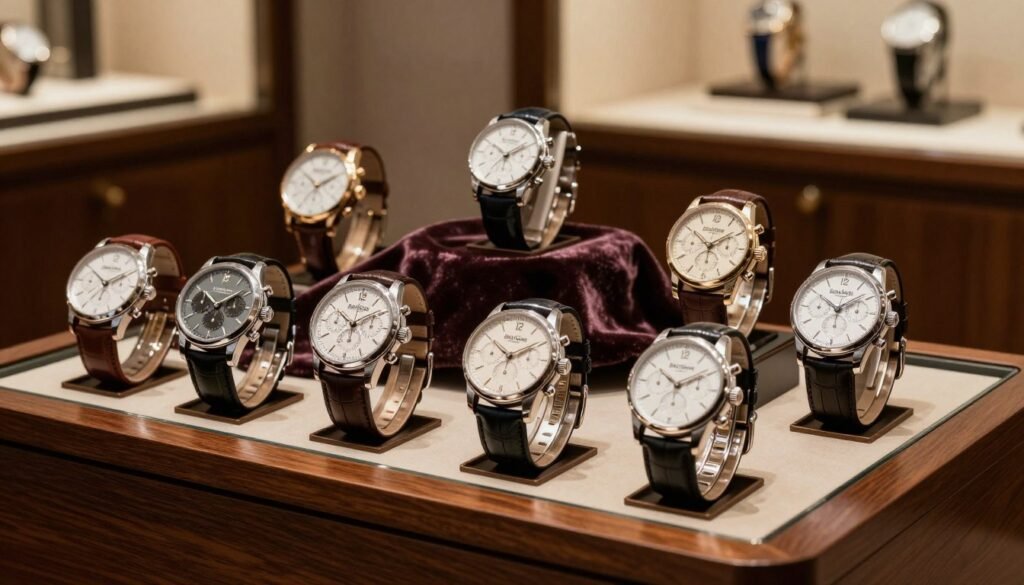
Start with how you will wear it
A chronograph you wear every day should be comfortable under a cuff and legible at a glance; a 39 to 41 mm case with a steel bracelet is the safest bet. For weekends and travel, a sportier case with a bezel scale makes sense. For formal wear, a slimmer two-register design in gold or on leather is more appropriate.
Steel, gold or something lighter
Steel is durable and easy to wear. Gold adds warmth and weight, and costs considerably more. Titanium and ceramic are lighter and more scratch-resistant but give a more technical look. Consider the bracelet too: it accounts for much of the comfort and a fair part of the price.
Manual or automatic
Manual-wind chronographs such as the Speedmaster Moonwatch are thinner and offer the pleasure of a daily ritual. Automatic chronographs are more convenient if you rotate between watches less often. Both are equally “luxury”; the choice is personal.
Set a budget band
- Under $10,000: TAG Heuer Carrera, Omega Speedmaster, IWC Portugieser, most Breitling B01 models.
- $10,000 to $25,000: Zenith Chronomaster, Rolex Daytona at list, precious-metal Breitling and Omega.
- $25,000 and up: Audemars Piguet, Patek Philippe, Vacheron Constantin, A. Lange & Söhne and rare limited editions.
Buying a luxury chronograph in the USA
Authorized dealers offer the full manufacturer warranty, which is typically two to five years, and guaranteed authenticity. Reputable pre-owned specialists can offer savings, discontinued references and immediate availability for watches with long wait lists, but always check that the watch comes with box, papers and a recent service record, and buy from a seller with a clear returns and authenticity guarantee.
Budget for maintenance as well. A chronograph has more parts than a simple watch, and most brands recommend a full service every five to ten years; for complex calibres, that can cost from several hundred to several thousand dollars. Finally, insure the watch from the day you buy it, either with a specialist jewelry policy or a scheduled item on your homeowner’s insurance.
Frequently Asked Questions
What is the difference between a chronograph and a chronometer?
A chronograph is a watch with a stopwatch function. A chronometer is a watch whose movement has been certified for accuracy, usually by COSC. Many luxury chronographs, such as the Rolex Daytona and Breitling Navitimer, are both.
Can I leave the stopwatch running all the time?
On a chronograph with a vertical clutch, such as the Breitling B01 or Rolex 4131, yes; it is designed to run continuously with minimal wear. On older or horizontal-clutch designs, it is better to use the stopwatch only when needed.
Are luxury chronograph watches a good investment?
A few references, notably the steel Rolex Daytona and certain Patek Philippe and Audemars Piguet models, have historically held or increased their value, but markets move. Buy one because you love wearing it, and treat any appreciation as a bonus.
What is the best luxury chronograph for a first purchase?
For most buyers, the Omega Speedmaster Moonwatch, a Breitling Navitimer B01 Chronograph 41 or a TAG Heuer Carrera offer the best mix of history, quality and value. If budget allows and you can find one, the Rolex Daytona remains the benchmark.
How often does a chronograph need servicing?
Most manufacturers recommend a full service every five to ten years, depending on the calibre and how often the stopwatch function is used. Keep service receipts; they support resale value.
The final word
The best luxury chronographs reward you every time you press a pusher: a crisp click, a smooth sweep, a dial that tells you exactly what you need. Choose the movement first, the design second and the price band third, and you will end up with a chronograph that earns its place on the wrist for decades. For more, explore our guides in Watches & Jewelry.
Sources and further reading
- COSC: Swiss Official Chronometer Testing Institute
- LVMH group maisons and annual reports
- Bain & Company luxury market insights
Prices, availability and specifications change; we check brand and retailer pages before each update. See our editorial standards.