
Elite Soda is reader-supported. When you buy through links on our site, we may earn an affiliate commission at no extra cost to you. Read our affiliate disclosure.
This article may contain affiliate links. See our Affiliate Disclosure. For the wider category, see our watches & jewelry guide.
A traveler arriving in a new time zone may rely on a Rolex GMT watch to keep home time visible while adjusting to local schedules. For international travel, the choice is practical as well as personal: you may prioritize time-zone tracking, a particular appearance, or how comfortably a watch sits on your wrist. A 24-hour bezel is a rotating ring marked with 24 hours that lets you read a second time zone against the GMT hand. The right reference choice depends on which of those needs matters most to you.
Rather than treating every version as interchangeable, compare the feature that affects your daily use with the design you want to wear. The clearest route through the differences starts with how the GMT display works and how the model generations handle local time.
Key Takeaways
- The GMT-Master II adjusts local time independently.
- The 24-hour bezel helps track another zone.
- Bezel colors and metals vary by reference.
- Current case size is 40 mm.
- Price depends on configuration and condition.
How Do Rolex GMT Models Differ?
The key practical difference is that the GMT-Master II has an independently adjustable local hour hand. That independent adjustment lets you change local time without moving the 24-hour hand, so the watch can show local time, a reference zone, and a third zone.
The GMT-Master and GMT-Master II are related models, but the GMT-Master II’s local-hour hand can be set separately from its 24-hour hand. The GMT-Master was introduced in 1955 in collaboration with Pan American Airways. For the early model’s history and reference variations, see Hodinkee’s historical overview of the GMT-Master.
The GMT-Master II’s independent local-hour adjustment is the practical distinction: it changes local time without resetting the 24-hour hand.
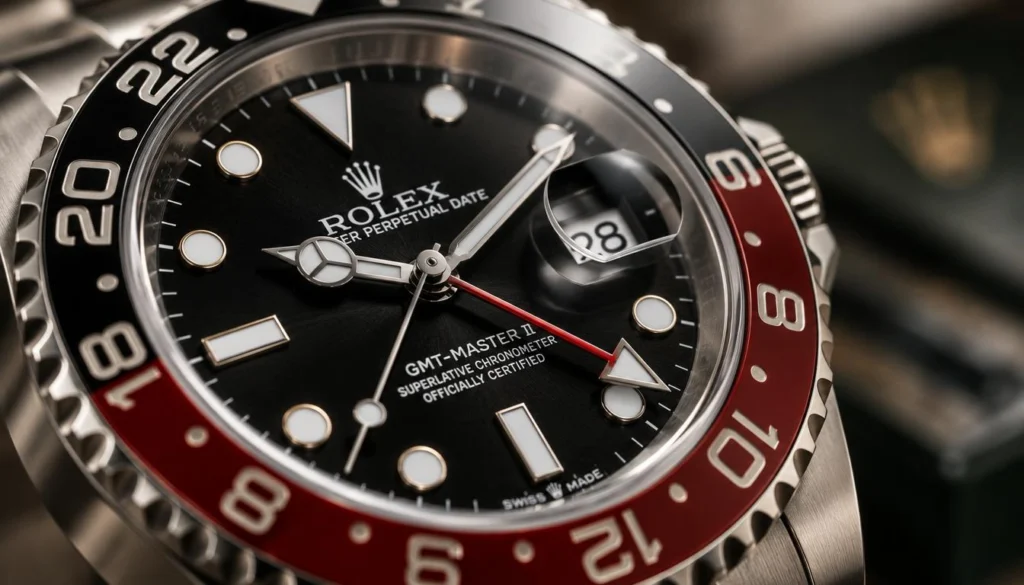
GMT-Master and GMT-Master II
GMT means Greenwich Mean Time. The GMT-Master was developed for pilots who needed to keep track of time in more than one place. The GMT-Master II retains that dual-time purpose and makes travel adjustments simpler: you can move the local hour hand forward or backward while leaving the 24-hour hand on its reference time. This avoids resetting the reference zone each time you change time zones.
The model names can be easy to conflate when comparing listings. A Rolex GMT Pepsi search, for example, may point to a bezel color nickname rather than a separate generation. For the basic comparison, look at the model line and reference number, then check whether the local-hour hand adjusts independently.
Reading the 24-Hour Display
The arrow-tipped 24-hour hand points to an hour on the bezel. Because the bezel uses a full 24-hour scale, its position distinguishes day from night in the reference zone. Set the watch so the hand shows the time in the zone you want to keep visible, then use the bezel to compare another zone.
Use the display in three steps:
- Set the local time with the hour hand.
- Align the 24-hour hand with the reference zone.
- Rotate the bezel to read another zone.
On the GMT-Master II, the local hour hand can move independently, while the 24-hour hand continues to mark the reference zone. Rotating the bezel shifts the displayed reading against the same hand, which lets the wearer read a third time zone. Once that distinction is clear, the visible bezel and material choices help distinguish individual references.
Which Bezel Colors and Materials Stand Out?
The red-and-blue Pepsi bezel is an easy-to-recognize example of how color distinguishes a reference. These familiar nicknames describe bezel colors, not official model names, so they can help you identify a look but do not replace checking the exact reference.
Bezel nickname and reference are not the same thing. A Rolex GMT-Master II Pepsi or Rolex GMT Pepsi search may describe a recognizable color combination, but exact reference availability varies. The same caution applies when comparing color and metal: not every bezel is offered with every material.
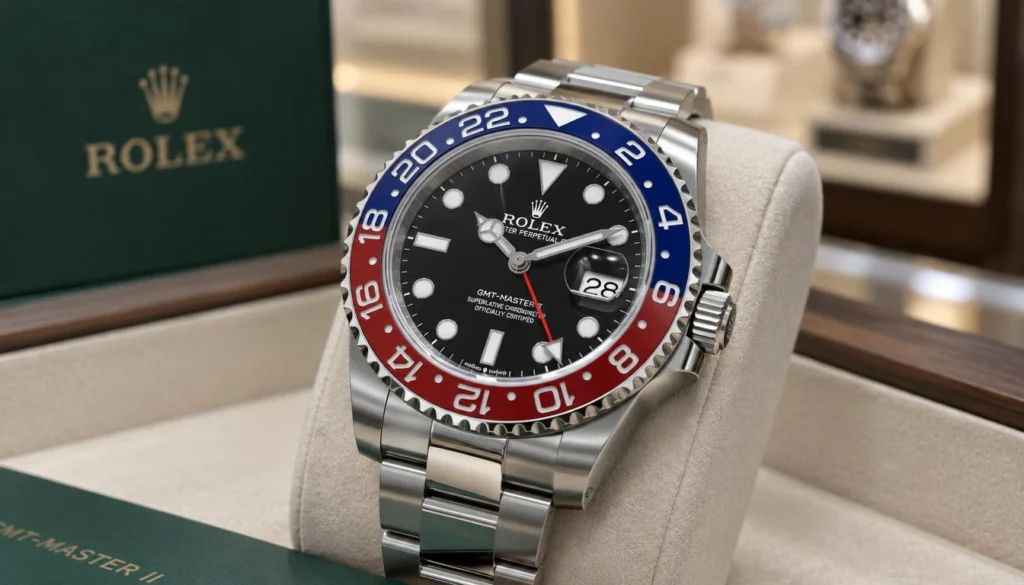
Pepsi, Batman, Coke, and Gray-and-Black Bezels
The names offer quick shorthand when scanning photos or talking about a particular style. The table separates each nickname from the colors it describes and notes the key identification point.
| Nickname | Bezel colors | What to know |
|---|---|---|
| Pepsi | Red and blue | Nickname for a two-color bezel |
| Batman | Blue and black | Nickname for a two-color bezel |
| Coke | Black and red | Nickname for a two-color bezel |
| GRNR/Bruce Wayne | Gray and black | Nicknames used for gray-and-black bezels |
Because the terms are informal, a listing’s nickname alone does not establish its exact model or configuration. Check the reference and the actual color pairing in the product description or photographs, particularly when searching for a Rolex GMT-Master II Pepsi.
Oystersteel, Gold, and Mixed-Metal Options
Oystersteel, yellow gold, Everose gold, and white gold appear as material options across the Rolex GMT models range. A Rolex GMT-Master II gold configuration may have a different look and feel from a steel version, and a two-tone design combines steel with gold. The specific gold and steel arrangement depends on the reference.
Material names tell only part of the story. A gray-and-black bezel, for instance, does not mean that every metal option is available with that color. Confirm the full configuration rather than assuming a familiar nickname applies across all case and bracelet combinations. From appearance, the next useful comparisons are fit, bracelet, and movement details that shape daily wear.
What Size and Movement Should You Expect?
The standard current GMT-Master II case measures 40 mm; older references can differ. That figure is a starting point, not a guarantee that every watch with GMT-Master on the dial will have the same dimensions.
The number alone cannot tell you how the watch will sit on your wrist. Wrist shape, case proportions, and bracelet fit all affect comfort, so trying a specific watch on is useful when possible. Current models are offered on Oyster or Jubilee bracelets, with the choice changing both the look and feel.
Rolex GMT-Master II Size and Fit
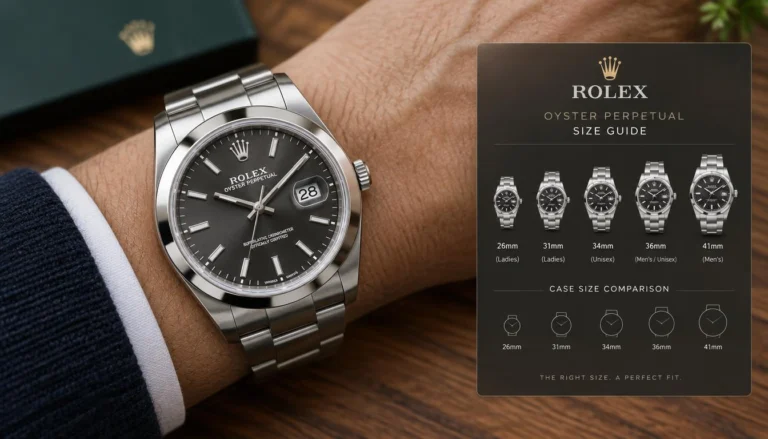
When comparing Rolex GMT-Master II size, begin with the 40 mm measurement for the standard current case, then account for the watch’s shape on your wrist. A case can feel more prominent or less prominent depending on your wrist and how the bracelet rests. The same size can wear differently from one person to another, so a measurement is not a substitute for a try-on.
Older references may have different dimensions and design details. If you are comparing a vintage or discontinued watch with a current model, use the exact reference rather than applying today’s standard size to the entire model family. Bracelet adjustment also matters: a comfortable case can still feel wrong if the bracelet does not fit well.
Rolex GMT-Master II Two-Tone Models
A Rolex GMT-Master II two-tone configuration pairs Oystersteel with gold. The particular arrangement depends on the reference, so “two-tone” identifies a material combination rather than one uniform design. Gold can make the watch feel more formal or visually prominent, while steel gives the configuration a different overall character.
Compare the actual case and bracelet materials for the reference you are considering. Do not assume that every gold type, bezel, and bracelet combination is available together. The same distinction matters if you are choosing by appearance: the words “two-tone” are a useful starting point, but the exact reference tells you which elements use steel and which use gold.
Movement and Bracelet Choices
The current GMT-Master II uses self-winding Calibre 3285, with an approximately 70-hour power reserve and Superlative Chronometer certification. Those specifications describe the current model, not every historical GMT reference. Older watches use different movements, so check the reference and generation when assessing a particular listing.
Current GMT-Master II models come with either an Oyster or Jubilee bracelet. Oyster has a more straightforward, sport-oriented appearance; Jubilee has a more intricate pattern and a different feel on the wrist. Neither is universally better, so consider how each looks with the case and how it feels during a try-on. These specifications narrow the field, while reference, material, condition, and buying route shape the cost.
What Does a Rolex GMT Cost in the U.S.?
Two otherwise similar Rolex GMT listings can have different prices if one uses a different metal or has more wear. The exact configuration matters: price depends on the reference, metal, bracelet, condition, and whether the watch is purchased at retail or on the secondary market.
There is no single price that applies to every Rolex GMT. Current U.S. retail pricing and secondary-market asking prices can differ, and the figures change with the exact watch being offered.
Compare like with like: reference, metal, bracelet, and condition all affect the price of a Rolex GMT.
What Changes the Price
A Rolex GMT-Master II price reflects more than the model name. Metal, bracelet, and reference affect the configuration, while condition matters on both new and pre-owned watches. Retail pricing and secondary-market listings are separate routes, so compare prices within the same route as well as across matching configurations.
For a Rolex GMT for sale, assess the exact reference and the watch’s pre-owned condition rather than relying on a nickname or a broad model label. Check current U.S. pricing at the time you plan to buy, since current retail prices and listings can change.
Comparing New and Pre-Owned Listings
Use this checklist to evaluate each listing:
- Confirm the reference number.
- Identify the metal and bracelet.
- Inspect the watch’s condition.
- Verify what documentation accompanies it.
- Compare the same reference across listings.
Documentation can help establish what accompanies a watch, but it is only one part of assessing a listing. Compare descriptions and photographs against the reference and configuration, and distinguish clearly between retail and secondary-market offers. A price comparison is most useful when the watches match on those details.
Whether the cost feels worthwhile is a personal decision based on the time-zone display’s use to you, your preferred style, and the total ownership cost. A Rolex GMT is not a guaranteed investment. Narrow your options to the reference and configuration that fit your priorities before weighing individual listings.
Conclusion
The right choice depends first on whether the GMT function and wearing style suit your needs. The GMT-Master II’s independently adjustable local hour hand is its defining practical distinction, while the reference, material, and fit determine which configuration works best for you.
Choose a reference that matches how you plan to use and wear the watch, then compare its exact metal, bracelet, and condition in person or through current listings. Shortlist a reference and verify its configuration before buying.
Explore more in our rolex gmt overview covering this pillar.
Related reading: hublot · breitling navitimer · used rolex.
How we research: EliteSoda desk-researches brand sites, auction houses, authorized dealers, and established marketplaces such as Chrono24 and major hotel/resort directories. We do not invent lab tests, prices, or quotes.
Frequently Asked Questions
What does GMT mean for a Rolex?
GMT means Greenwich Mean Time, and a Rolex GMT watch uses its 24-hour hand and bezel to track another time zone. The arrow-tipped hand points to the reference time on the bezel’s 24-hour scale. Rotating the bezel changes the displayed time against that hand, which can help you compare a different zone without changing the reference time.
How much does a Rolex GMT cost?
There is no single price for a Rolex GMT. The exact reference, metal, bracelet, and condition all affect the amount, as does whether you buy at retail or on the secondary market. When comparing listings, match the configuration and condition rather than relying on the model name alone, and check current U.S. pricing when you are ready to buy.
Is a Rolex GMT worth it?
A Rolex GMT may be worth the cost if you will use the time-zone display, like the design, and are comfortable with the ownership expense. Its value depends on your needs and preferences, not on a promise of investment returns. Consider how often you travel or track another zone, how the watch fits your style, and the cost of the specific configuration.
Can a Rolex GMT-Master II track three time zones?
Yes, a Rolex GMT-Master II can show a third time zone by rotating the bezel after setting local time and the 24-hour hand. The local hour hand shows local time, while the 24-hour hand retains the reference zone. Turning the bezel shifts the reading against that hand, allowing you to read another zone on the 24-hour scale.
Are all Rolex GMT-Master II watches 40 mm?
No, 40 mm is the standard case size for the current GMT-Master II, but older references can differ. The measurement is useful when comparing current models, not as a rule for every watch in the line. If you are considering an older reference, check its exact specifications and try it on to judge how its proportions feel on your wrist.
Does every Rolex GMT-Master II use Calibre 3285?
No, Calibre 3285 is the movement used in the current GMT-Master II, while older references use different movements. The movement depends on the reference and generation, so the model name alone does not identify the caliber. When assessing a specific watch, match its reference to its movement rather than assuming all GMT-Master II models share the current specification.
Sources and further reading
Prices, availability and specifications change; we check brand and retailer pages before each update. See our editorial standards.