Elite Soda is reader-supported. When you buy through links on our site, we may earn an affiliate commission at no extra cost to you. Read our affiliate disclosure.
This article may contain affiliate links. See our Affiliate Disclosure. For the wider category, see our watches & jewelry guide.
A watch worn from the morning commute through the evening should feel comfortable before a dive watch’s technical features matter. For everyday wear, a rugged case and bold dial are only part of the appeal: the watch also needs to sit well on your wrist and make the time easy to read at a glance. A heavy case or crowded display can become a nuisance during desk work, errands, and dinner, even if it looks impressive in a product photo.
The common mistake is choosing around imagined extreme conditions instead of the routine you actually have. A watch for occasional pool visits and office days has different demands from equipment used for regular scuba diving. A practical selection process starts with your personal priorities, then examines fit.
Key Takeaways
- Start with the tasks you do most.
- Give wrist comfort equal weight to durability.
- Check whether the dial reads quickly.
- Match features to real use, not imagined extremes.
- Try a shortlist on before buying.
How to Choose a Dive Watch for Everyday Wear
The best choice is the one that fits your daily needs, not the one with the longest specification list. For everyday wear, intended use, comfort priorities, legibility, and maintenance preference matter more than a feature you may never use.
There is no single best choice across analog watches, solar options, and dive computers. A traditional timepiece may suit you if you value a familiar dial, while a solar watch reduces routine battery changes and a dive computer serves a different, dive-specific purpose.
Choose for the needs you have, not for the longest list of specifications.
What Makes the Best Dive Watch for Everyday Wear?
The best dive watch for everyday wear works with the hours you actually spend in it. Think about whether you need a clear time display during a busy commute, a case that feels unobtrusive at a keyboard, or a device that can support scuba use. If you rarely enter the water, prioritize comfort and easy reading over specialized functions.
Maintenance matters, too. Some owners prefer a watch that runs on a battery or stored solar power; others enjoy the mechanics and care associated with an automatic watch. Decide how often you are willing to manage charging, winding, battery replacement, or servicing.
Set Priorities Before Comparing Specifications
Rank your needs in this order before comparing models:
- Write down where and how often you will wear it.
- Choose your comfort and readability requirements.
- Decide how much ongoing maintenance suits you.
- Separate essential features from attractive extras.
A model that meets your top priorities is a stronger candidate than one with impressive specifications that do not serve your routine. From those broad priorities, move to the physical features that affect comfort and readability.
Which Features Matter for Comfort and Readability?
A watch can look balanced in a product photo and still feel bulky under a sleeve. Case diameter, thickness, lug fit, and weight determine whether a watch stays comfortable through a full day, while dial legibility depends on contrast and clear markers.
Judge the watch on your wrist, not by its diameter alone. Long lugs can extend past a narrow wrist, and a thick case may press against the back of your hand when you bend your wrist. Low-light legibility depends on visible markers and hands, not simply a large dial.
Case Size, Thickness, and Lug Fit
Case size is usually listed as diameter, but that number does not show the full footprint. Check how far the lugs reach across your wrist and whether the case shifts when you move. Weight also affects wrist comfort: a heavy metal case can feel tiring over a long workday, even when the diameter seems reasonable.
Dial, Bezel, and Strap in Daily Use
Look for hands and markers that stand apart from the dial, with enough contrast to read quickly. A unidirectional rotating bezel is a bezel that turns only in the direction that makes the elapsed-time reading shorter, helping prevent an accidental extension of the displayed dive time. The strap material also shapes daily comfort: rubber handles moisture easily, while metal and fabric feel different against skin and clothing.
Use this try-on checklist before deciding:
- Wear it for an hour and note pressure or shifting.
- Flex your wrist to check for pinching.
- Test it under a shirt cuff.
- See whether the closure allows a secure fit.
Once fit and readability are clear, turn to what the water-resistance markings do and do not mean.
How Much Water Resistance Is Enough?
A water-resistance number is a laboratory rating, not a dive plan. Match the rating to likely use, and follow the manufacturer’s instructions for the specific watch.
A printed depth rating comes from pressure testing; it does not promise that every watch is safe at that depth during use. Seal condition can affect water resistance, so a watch with worn or damaged seals may not perform as expected.
| Rating | Typical context | What to verify | Important limit |
|---|---|---|---|
| 100 meters | Swimming; ISO 6425-compliant divers’ watches have this minimum | Manufacturer’s use instructions | Not a guaranteed safe operating depth |
| 200 meters | Common practical choice for recreational scuba watches | Seal condition and instructions | Printed depth is not a dive plan |
| 300 meters or more | Higher-rated water use, including some diving contexts | Model-specific instructions and seal condition | Rating alone does not establish safe use |
A rotating bezel helps you track elapsed time, but it does not measure depth or replace dive equipment. Treating the number on the dial as a guaranteed safe operating depth is a mistake. With water use in perspective, compare the kinds of movements and displays that power everyday options.
Which Movement or Display Suits Your Routine?
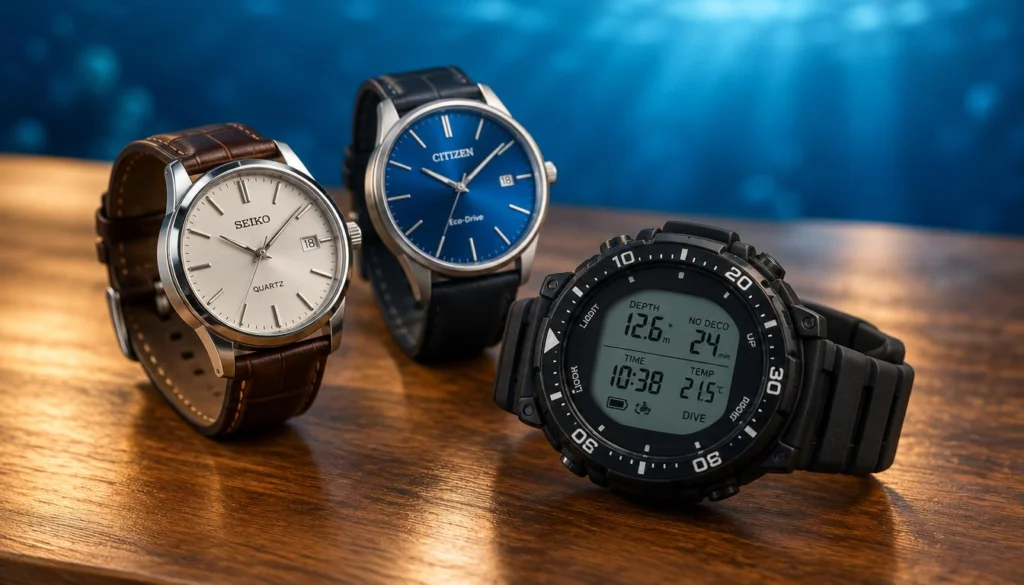
Two watches with similar rugged styling can have very different power needs. A quartz movement uses a battery, a solar watch converts light into stored electrical power, and an automatic mechanical movement uses a rotor to wind the mainspring.
Choose by whether you value simplicity, traditional mechanics, or electronic dive functions. A digital dive watch may be a timepiece or a dive computer, so its display alone does not establish what it can do.
Battery-Powered and Solar Movements
A battery-powered quartz watch is straightforward to use, though its battery eventually needs changing. Solar quartz reduces the need for routine battery replacement by storing energy from light. It still needs access to light, so consider whether you often keep a watch covered by long sleeves or leave it in a dark drawer.
Automatic Watches and Dive Computers
An automatic movement winds as the rotor moves with your wrist. It avoids a battery, but it may need winding after a period unworn and can require mechanical servicing. A dive computer is an electronic instrument for tracking a dive and can display information beyond ordinary timekeeping.
| Type | Power source | Everyday strength | Main trade-off |
|---|---|---|---|
| Quartz | Battery | Simple daily timekeeping | Battery changes |
| Solar quartz | Light stored as electrical power | Fewer routine battery changes | Needs access to light |
| Automatic mechanical | Rotor-wound mainspring | Traditional mechanical operation | Winding and servicing |
| Dive computer | Electronic power | Can display dive-specific information | More functions than basic timekeeping |
Do not assume every digital dive watch is a dive computer. Identify the functions you need, then choose the device type that provides them. After choosing the kind of device, judge whether its price reflects features you will actually use.
How Can You Avoid Overpaying for Features?
A lower-cost option can be a sensible choice when its specifications match the way you will use it. The price can reflect movement, materials, construction, certification, finishing, and service needs, so cost alone does not show whether a watch is suitable.
For the best inexpensive dive watch, look for a clear specification sheet, a usable bezel, a readable dial, and a secure strap. Assess a Casio dive watch by its exact model specifications, not by the brand name alone.
Use this four-point value checklist:
- Verify the stated rating and intended use.
- Inspect the clasp for a secure, comfortable fit.
- Check access to parts and servicing.
- Pay only for functions you expect to use.
An affordable dive watch may meet your needs without costly extras, but the lowest purchase price is not always the least expensive choice if replacement parts or servicing are difficult to access. Once practical value is clear, consider how the design works with everyday clothing.
How Can a Sporty Bezel Fit Everyday Clothes?
A bold bezel can work as an everyday detail if the rest of the outfit stays simple. The case finish, bezel color, bracelet or strap, and clothing formality all shape the overall look, so keep the pairing deliberate rather than matching every detail.
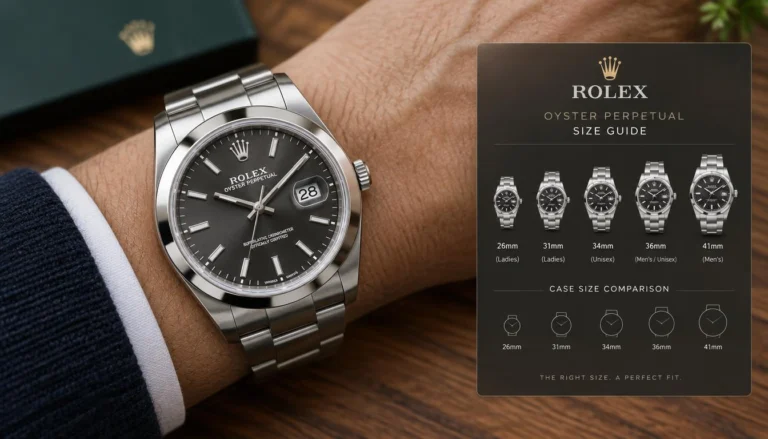
A watch should suit your personal style as well as the occasion. A Rolex dive watch is one luxury-style choice, but its name does not decide whether it fits your wrist or wardrobe.
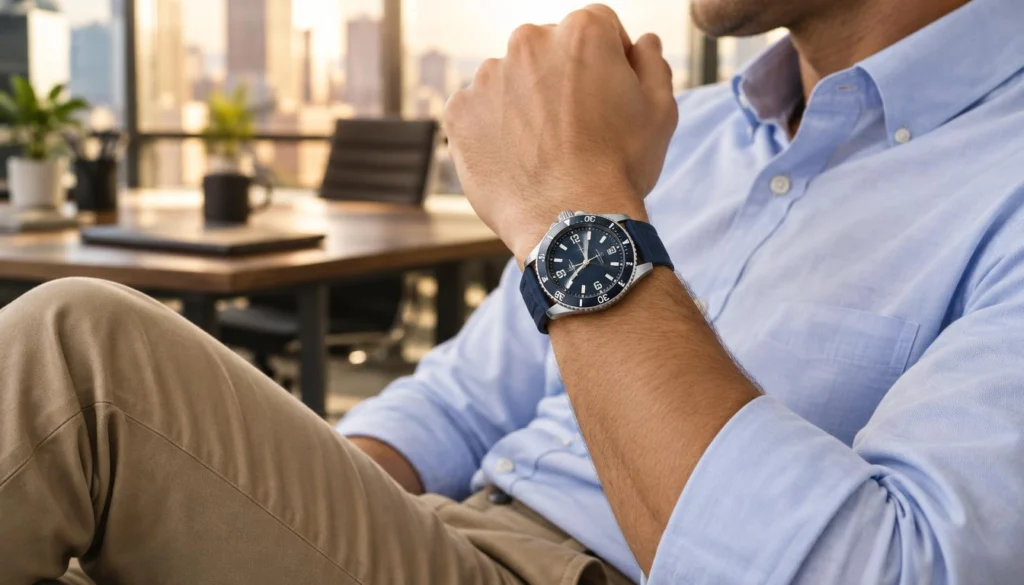
Try these outfit pairings as starting points:
- A metal bracelet with a business-casual outfit.
- A rubber strap with casual weekend clothes.
- A fabric strap with relaxed layers.
A polished case and restrained bezel can look at home with sharper clothing, while a rubber strap feels more at ease with casual clothes. A fabric strap adds a softer, less formal note. One exception: a thick case or prominent bezel may catch on a close-fitting cuff. Separate the watch’s role as an accessory from its role as equipment for an actual dive.
Do You Need a Dive Computer for Scuba?
For scuba, a traditional timepiece and a dive computer do different jobs. A watch can help track elapsed time, but it does not replace the depth and decompression information a dive computer provides.
Recreational scuba divers generally rely on dive computers to track depth and time and manage decompression information. A traditional watch may still be useful as a backup or for everyday wear, but elapsed-time tracking alone cannot supply those dive-specific readings.
A traditional watch can track elapsed time, but it cannot replace a dive computer’s depth and decompression information.
What Should a Watch for Professional Divers Handle?
A professional divers’ watch needs to perform reliably in the conditions and work pattern it is intended to support. That means clear time reading and dependable elapsed-time tracking when those functions are needed. Professional divers do not all use the same equipment, and a watch should not be treated as a replacement for the dive tools required for a particular job.
When Does a Dive Watch Computer Make Sense?
A dive watch computer makes sense when you need dive-specific electronic functions, rather than only a traditional display for time. Check what information it provides and the operating limits stated for that model. A Garmin dive watch is one type of option to assess by its stated functions and limits, not by the brand name alone.
A general-purpose smartwatch is not automatically a dive instrument. Confirm that the specific model has stated dive modes and operating limits for the intended use; a familiar touchscreen or water-ready design is not enough to establish that. Bring the decision back to your actual use, then take one practical next step in the conclusion.
Conclusion
A practical everyday choice starts with the wearer’s routine, not an impressive specification. The right fit balances comfort with the capabilities you will genuinely use, whether that means reliable timekeeping for daily errands or equipment designed for scuba functions.
Start with your own priorities. Write down three things you need from a watch, then try on options that meet them. Pay attention to how each one feels after a few minutes on your wrist, not just how it looks in a display case. The next step is to try on a shortlist that meets your three priorities before buying.
Explore more in our dive watch overview covering this pillar.
Related reading: luxury watches for men · most expensive watch · hublot.
How we research: EliteSoda desk-researches brand sites, auction houses, authorized dealers, and established marketplaces such as Chrono24 and major hotel/resort directories. We do not invent lab tests, prices, or quotes.
By the numbers: Under ISO 6425, a watch sold as a diver’s watch must be water resistant to at least 100 m, carry a unidirectional timing bezel, and remain readable at 25 cm in total darkness. Many popular models go further, with 200 m or 300 m ratings, which is useful headroom rather than a requirement for swimming. The standard also calls for each watch to be tested at 125% of its rated pressure, so a 200 m diver is checked at the equivalent of 250 m.
Frequently Asked Questions
What is the point of a dive watch?
A dive watch is designed to make time easy to read and elapsed time easy to track in demanding conditions. Its bezel can mark elapsed time, while high-contrast hands and markers support quick reading; robust construction is another common feature. Many everyday owners value the bold, practical design even if they never use the watch for diving.
What are the top 5 dive watches?
There is no universal top-five ranking because the right choice depends on your needs. Build a shortlist by category: affordable quartz, solar, automatic, compact fit, and dive-computer functions. Compare models within each category by their stated features and how they feel on your wrist. A computer with dive functions is not necessarily a substitute for a traditional everyday watch.
Do divers use dive watches anymore?
Yes, many scuba divers use a dive computer for depth and decompression information rather than relying on a traditional watch. A traditional watch may serve as a backup or everyday accessory, and its elapsed-time function can still be useful. It does not provide the full information a dive computer uses to support dive planning and monitoring.
What is the 3 watch rule?
The 3 watch rule is an informal collection idea, not a fixed requirement. It often describes choosing one watch for dressier occasions, one for everyday use, and one for sport or outdoor activities. You can adapt those roles to your routine, combine them in fewer watches, or ignore the idea entirely if a different setup works better.
Why do lefties wear watches on their right hand?
Many left-handed people wear a watch on the right wrist to keep it on the less-used hand. That can reduce interference during writing or other tasks, though individual habits vary. There is no required side: comfort, the watch’s crown position, and personal preference matter more than a rule about handedness.
Sources and further reading
- COSC: Swiss Official Chronometer Testing Institute
- LVMH group maisons and annual reports
- Bain & Company luxury market insights
Prices, availability and specifications change; we check brand and retailer pages before each update. See our editorial standards.